
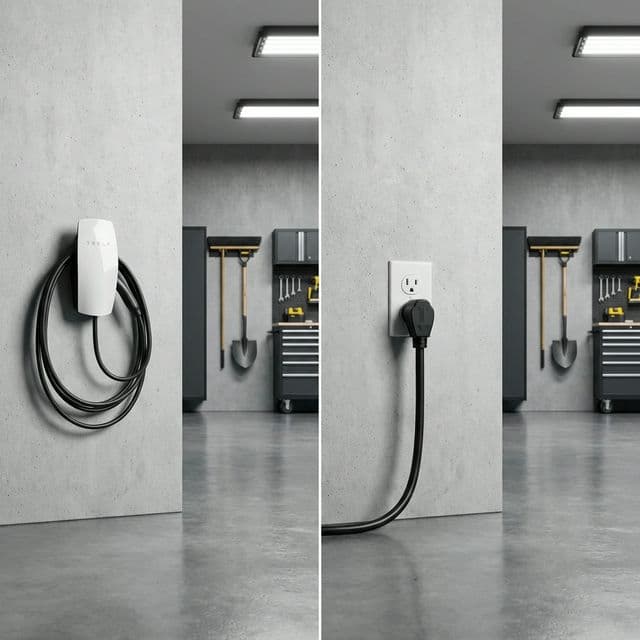
Tesla Wall Charger vs NEMA 14-50 Outlet: Cost, Speed & Which to Install
Tesla owners in Henderson commonly ask: should you hardwire a Tesla Wall Connector, or have an installer put in a NEMA 14-50 outlet and plug in your Mobile Connector? Both give you Level 2 charging. The right choice depends on your budget, how fast you need to charge, and whether you might switch EV brands down the road.
Quick answer: The Tesla Wall Connector costs $950-$1,600 installed and charges at 44 miles/hour. A NEMA 14-50 outlet costs $350-$900 installed and charges at 30 miles/hour. The federal 30C tax credit that used to apply to both ended for chargers placed in service after June 30, 2026 (see our tax credit guide).
4-Axis Comparison: Tesla Wall Connector vs NEMA 14-50
The cleanest way to make this decision is to weigh four axes against your situation. Here is the side-by-side using typical ranges reported for Nevada installs as of 2026 (your quote will vary):
| Axis | Tesla Wall Connector (Gen 3) | NEMA 14-50 + Mobile Connector |
|---|---|---|
| Cost (installed in Henderson) | $950 - $1,600 | $350 - $900 |
| Speed (continuous) | 48A @ 240V = 11.5 kW, ~44 mi/hr | 32A @ 240V = 7.7 kW, ~30 mi/hr |
| Convenience | Hardwired, 24 ft cable, holster, app-controlled, no plug to wear out | Portable charger plugs in -- carry it on road trips, swap if vehicle changes |
| Future-proofing | Best for Tesla / NACS households; power-sharing supports a second Tesla | Brand-agnostic -- any current or future EV with any portable EVSE works |
Tesla Wall Connector (Gen 3) -- Detailed Specs
- Continuous output: 48 A (up to 11.5 kW at 240 V)
- Charging rate (Model 3 LR / Y): ~44 miles per hour of charging
- Circuit required: 60 A 2-pole breaker, 6 AWG Cu (NEC 625.41, 125% continuous load rule)
- Connection: Hardwired -- no plug
- Cable: 24 ft tethered, NACS connector (J1772 adapter included for non-Tesla EVs)
- Enclosure rating: IP55 (indoor/outdoor rated for direct exposure to rain and dust)
- Smart features: Wi-Fi, Tesla app integration, OTA firmware updates, power sharing (up to 4 units on one circuit)
- Operating temp: -22°F to 122°F -- handles Henderson's 115°F summer attic temps
- Configurable amperage: 12 A to 48 A in software (down-throttle if panel capacity is tight)
- Source: Tesla Wall Connector spec sheet, tesla.com support
NEMA 14-50 + Tesla Mobile Connector -- Detailed Specs
- Continuous output: 32 A (up to 7.7 kW at 240 V) -- limited by the Mobile Connector, not the outlet
- Charging rate (Model 3 LR / Y): ~30 miles per hour of charging
- Circuit required: 40 A 2-pole breaker (for 32 A continuous), 8 AWG Cu minimum -- 50 A breaker permissible if EVSE is hardware-limited to 32 A
- GFCI protection: Required under NEC 625.54 for any 125V-250V receptacle rated 50A or less that supplies an EVSE
- Outlet spec: Hubbell HBL9450A or Bryant 9450FR (industrial-grade) strongly recommended over residential-grade outlets, which fail at sustained 32A loads
- Connection: Plug-in (NEMA 14-50P male plug on the portable EVSE)
- Cable: ~20 ft on Tesla Mobile Connector
- Smart features: None at the outlet; charging scheduling done in the vehicle's app
- Source: Tesla Mobile Connector spec, tesla.com support and NEC 625 (NFPA 70, 2023 edition)
Decision Tree: Which One Is Right for You?
The decision usually comes down to four questions:
1. Do you own only Teslas and plan to stay with Tesla / NACS?
- Yes → Tesla Wall Connector. Faster, cleaner, power-sharing if you add a second Tesla. The premium is worth it.
- No / mixed fleet → continue to #2.
2. Do you own multiple EV brands (or might switch brands in the next 5 years)?
- Yes → NEMA 14-50. Any portable EVSE works -- Ford, Hyundai, Rivian, Chevy. The outlet is universal; the portable charger swaps with the car. (If you specifically want a hardwired unit but brand-flexibility, see the ChargePoint Home Flex / Emporia options.)
- No → continue to #3.
3. Are you renting, or do you expect to move within 3-5 years?
- Yes → NEMA 14-50. The outlet stays as a home value-add (any future EV owner can use it), and you take the Mobile Connector with you. Removing a hardwired Wall Connector is messier and rarely worth it.
- No → continue to #4.
4. Is a panel upgrade likely in the next few years anyway (older home, near capacity)?
- Yes / unsure → NEMA 14-50 for now. The 40-50 A draw is easier on a tight panel; you can always upgrade to a hardwired Wall Connector later when the panel is upgraded.
- No (200 A panel with plenty of headroom) → Tesla Wall Connector. No reason not to take the speed and smart features.
Some households install both (Wall Connector for the daily driver, NEMA 14-50 as a backup / guest spot), though most pick one.
What Is a NEMA 14-50 Outlet?
A NEMA 14-50 is a 240-volt, 50-amp outlet -- the same type used for electric ranges and RV hookups. It is a standardized receptacle, so any device rated for it can plug in.
For EV charging, you plug your car's portable charger (the Mobile Connector that came with your Tesla, or a third-party portable EVSE) into this outlet. Tesla's Mobile Connector with the NEMA 14-50 adapter delivers up to 32 amps, which equals roughly 7.7 kW of charging power.
Key specs:
- 240V / 50A circuit (charger draws up to 32A continuously on a 40A breaker, or up to 40A on a 50A breaker depending on the EVSE)
- Uses your existing portable charger
- Standard outlet -- works for other 240V appliances too
- No smart features (unless your portable EVSE has them)
What Is the Tesla Wall Connector?
The Tesla Wall Connector (Gen 3) is a hardwired Level 2 charger built for Tesla vehicles. It also works with other EVs that have the now-standard NACS port or a J1772 adapter.
It wires directly to your electrical panel -- there is no plug. It supports up to 48 amps on a 60-amp circuit, delivering up to 11.5 kW of power.
Key specs:
- 240V / 60A circuit (draws up to 48A continuously)
- Hardwired installation (no outlet)
- Built-in Wi-Fi for scheduling and monitoring via the Tesla app
- Sleek, wall-mounted design
- Power sharing between multiple Wall Connectors
- 24-foot cable length
Head-to-Head Comparison
Charging Speed
The Wall Connector wins here by a solid margin:
NEMA 14-50 + Mobile Connector:
- Draws 32A at 240V = ~7.7 kW
- Adds roughly 28-30 miles of range per hour
- Tesla Model 3 Long Range (0-100%): about 9.5 hours
- Tesla Model Y (0-100%): about 10 hours
Tesla Wall Connector (48A):
- Draws 48A at 240V = ~11.5 kW
- Adds roughly 44 miles of range per hour
- Tesla Model 3 Long Range (0-100%): about 6.5 hours
- Tesla Model Y (0-100%): about 7 hours
The Wall Connector charges 44% faster. If you charge overnight, both will have your car full by morning. Speed matters more if you commute 80+ miles daily, come home on low battery often, or charge multiple EVs on one circuit.
Installation Cost
Need a professional installation quote?
Get matched with a qualified local installer for a written quote. Free, no obligation.
NEMA 14-50 outlet installation in Henderson, NV:
- Outlet and cover plate: $15-$30
- 50-amp breaker: $15-$30
- Wire, conduit, and materials: $100-$300
- Electrician labor (1.5-3 hours): $150-$400
- City of Henderson permit: $75-$150
- Total: $350 - $900
Tesla Wall Connector installation in Henderson, NV:
- Wall Connector unit: $475
- 60-amp breaker: $20-$40
- 6-gauge wire, conduit, and materials: $120-$350
- Electrician labor (2-4 hours): $250-$600
- City of Henderson permit: $75-$150
- Total: $950 - $1,600
The Wall Connector costs $500-$700 more when you factor in the unit cost and the larger circuit.
Both options are common in Henderson. Request a free installation estimate and we'll match you with a qualified local installer. Ask them to confirm the permit, load calculation, and workmanship warranty in writing.
Electrical Requirements
NEMA 14-50:
- Requires a 40-amp or 50-amp double-pole breaker
- Uses 8-gauge or 6-gauge copper wire (depending on run length and amperage)
- Needs 40-50 amps of available capacity on your panel
Tesla Wall Connector (at 48A):
- Requires a 60-amp double-pole breaker
- Uses 6-gauge copper wire
- Needs 60 amps of available capacity on your panel
If your panel is near capacity, the Wall Connector's higher draw could be an issue. A 200-amp panel can handle a 60A circuit in most cases, but if you're running a large HVAC system, pool pump, electric water heater, and electric dryer, it could be tight. A load calculation by the installer should verify this.
The Wall Connector has configurable amperage from 12A to 48A, so if your panel can only spare 40-50 amps, an installer can dial it down.
Flexibility
NEMA 14-50 is more flexible:
- Any portable EVSE plugs in (not just Tesla's Mobile Connector)
- If you switch to a non-Tesla EV, the outlet still works
- You can unplug the charger and use the outlet for other 240V equipment
- You can take your portable charger on road trips
Tesla Wall Connector is more permanent:
- Hardwired, so it stays where it is installed
- Gen 3 now supports other EVs with NACS ports, which broadens compatibility
- Adds value for EV-owning buyers if you sell the house (a dedicated 240V circuit is always valuable regardless)
Smart Features
NEMA 14-50 + Mobile Connector:
- Basic charging, no app integration at the outlet
- You schedule charging through your car's software
- No energy monitoring at the charger level
Tesla Wall Connector:
- Wi-Fi connected with Tesla app integration
- Schedule charging to hit NV Energy's off-peak rates (saves $300-$500/year)
- Track energy usage and charging history
- Over-the-air firmware updates
- Power sharing: two Wall Connectors on the same circuit automatically split available power between two Teslas
Durability and Weather Resistance
Both are fine inside a garage. For outdoor mounting:
- NEMA 14-50: Needs a weatherproof outlet cover and GFCI protection per NEC. The outlet itself handles outdoor use with proper cover, but most portable chargers are not rated for permanent outdoor exposure.
- Tesla Wall Connector: IP56 water resistance. Designed for both indoor and outdoor use, including Henderson's extreme summer heat.
For outdoor installs in Henderson, the Wall Connector is the stronger option -- weather-sealed and no portable charger dangling from the wall.
When to Choose a NEMA 14-50 Outlet
Go with the NEMA 14-50 if:
- Budget is tight: You save $500-$700 upfront
- You might switch EV brands: Maximum flexibility with any portable EVSE
- Panel capacity is limited: 40-50A circuit vs 60A
- You already own a good portable EVSE: No reason to buy a second charger
- You want simplicity: Just an outlet -- nothing to configure or update
- You charge overnight: 30 miles/hour is plenty for most daily commutes
- You travel with your charger: Your Mobile Connector works at any NEMA 14-50 on the road
When to Choose the Tesla Wall Connector
Go with the Wall Connector if:
- You want maximum charging speed: 44 miles/hour vs 30 miles/hour
- You commute 80+ miles daily: Faster charging keeps up with heavy use
- You have two Teslas: Power sharing between two Wall Connectors is a major advantage
- You want a clean, permanent setup: Professional look, no loose cables
- Outdoor installation: Better weather resistance
- Smart features matter to you: Scheduling, monitoring, and app control
- Resale value: Wall Connectors are appealing to EV-owning buyers
What About Non-Tesla EVs?
If you drive a Chevy Equinox EV, Hyundai Ioniq 5, Ford Mustang Mach-E, or similar, the NEMA 14-50 route is often the better fit:
- You will use a J1772 portable EVSE that plugs into the outlet
- Dedicated wall chargers from ChargePoint, JuiceBox, or Emporia offer broader compatibility than the Tesla Wall Connector
- Newer EVs with NACS ports (the Tesla-standard connector now adopted by most manufacturers) can use the Tesla Wall Connector directly
If you are buying a 2025+ model from Ford, GM, Rivian, or most other manufacturers, your car has a NACS port and works with the Tesla Wall Connector out of the box.
A Third Option: Universal Wall Charger
If you want a wall charger without locking into Tesla's ecosystem, a universal Level 2 charger like the ChargePoint Home Flex or Emporia Smart Level 2 is worth considering (see our full best EV chargers roundup):
- Adjustable amperage (16A to 50A)
- J1772 connector (works with all EVs, including Tesla via adapter)
- Smart features and app control
- Hardwired or plug-in options
- Priced close to the Tesla Wall Connector
Installation Notes for Henderson, NV
No matter which option you choose, a few local details apply:
- Permits are required: The City of Henderson requires an electrical permit for both a NEMA 14-50 outlet and a Wall Connector installation. Your installer normally pulls it; confirm this in your quote.
- NEC compliance: All installations must meet the current National Electrical Code and Nevada amendments -- proper wire sizing, breaker protection, and GFCI requirements for certain locations.
- NV Energy coordination: Not needed for the charger installation itself, but a panel upgrade requires NV Energy to disconnect/reconnect your meter.
- HOA restrictions: Some Henderson HOAs have rules about exterior electrical equipment. Check your CC&Rs before mounting a charger outside. Nevada law (NRS 278.0208) protects homeowners' rights to install EV chargers.
Cost Over Time
Upfront price is only part of the picture. The two setups use the same electricity for the same miles, so energy cost does not separate them; what differs is the up-front cost and long-term wear.
| Line Item | Tesla Wall Connector | NEMA 14-50 |
|---|---|---|
| Typical installed cost | About $950-$1,600 | About $350-$900 |
| Energy used per mile | Same | Same |
| Wear point | Hardwired, no plug to wear | Outlet and plug take repeated plug cycles; a poor-quality receptacle can loosen or overheat under sustained load, so use a quality, correctly rated outlet |
| Charging speed | Up to 48A (about 44 miles/hour) | Up to 40A (about 30 miles/hour) |
Installed-cost ranges are typical figures reported for Nevada installs; your quote depends on wire run, panel capacity and the equipment you choose. Ask installers to itemize the outlet or charger, labor, breaker, permit and any panel work so you can compare like for like.
The TOU savings affect both setups equally, so this is not a tiebreaker between the Wall Connector and NEMA 14-50 -- but it does affect the all-in cost of running either setup.
Bottom Line
Here is how the choice typically breaks down:
- Tesla owner staying with Tesla: Get the Wall Connector. The faster charging, cleaner look, and smart features justify the extra $500-$700.
- Budget-conscious or unsure about your next car: Get a NEMA 14-50 outlet. Lowest cost, maximum flexibility.
- Two EVs or planning a second: The Wall Connector's power sharing makes it the obvious choice.
Frequently Asked Questions
Is the Tesla Wall Connector worth the extra cost?
If you drive a Tesla and commute more than 40 miles daily, yes. The 44% faster charging speed and built-in smart features pay off quickly. For shorter commutes where overnight charging is enough, a NEMA 14-50 does the same job for $500-$700 less.
Can I use a Tesla Wall Connector with a non-Tesla EV?
Yes, if your vehicle has a NACS port. Most 2025+ models from Ford, GM, Rivian, and others now use NACS. Older EVs with J1772 connectors need a separate adapter or a different wall charger.
How long does installation take for either option?
A NEMA 14-50 outlet install takes 1.5-3 hours. A Tesla Wall Connector takes 2-4 hours. Both require a City of Henderson permit, and the full process from permit to final inspection runs about 5-8 business days.
Do I need a panel upgrade for either option?
Not always. A NEMA 14-50 needs 40-50 amps of panel capacity. The Wall Connector needs 60 amps. If your home has a 200A panel with available space, you are fine. Homes with 100A panels or panels near capacity will need an upgrade ($1,800-$3,500).
Ready to get your charger installed? Request a free installation estimate and we'll match you with a qualified local installer. Ask them to confirm the permit, load calculation, and workmanship warranty in writing.
Disclaimer: This article is for informational purposes only. Charging speeds, costs, and specifications are based on manufacturer data and typical Henderson, NV installations as of early 2026. Your actual results may vary. Always have EV charging equipment installed by a licensed electrician who can assess your specific electrical system. Consult a licensed professional for personalized advice.