
EV Charger Permit Pull & Inspection in Henderson, NV: Complete Walkthrough
If you are installing a Level 2 EV charger at your Henderson home, you need an electrical permit and a passing inspection. No exceptions. I have pulled hundreds of these permits and sat through just as many inspections, so I am going to walk you through exactly what to expect at every step.
Why the Permit and Inspection Matter
The permit is not just bureaucracy. When the City of Henderson issues an electrical permit, they are creating a paper trail that proves your installation was done to code. That matters for three reasons:
- Insurance: If an electrical fire starts from unpermitted work, your homeowner's insurance can deny the claim. I have seen this happen.
- Home sale: When you sell your home, the buyer's inspector will flag unpermitted electrical work. It can delay closing or kill the deal.
- Safety: The NEC (National Electrical Code) 2023 requirements for EV charger circuits exist because cars draw significant sustained loads. A 40-amp circuit running for 8 hours every night needs to be installed correctly.
Step 1: Pulling the Permit in Henderson
Online Application
The City of Henderson uses an online permit portal through their Community Development Department. Here is the process:
- Go to the City of Henderson's online permit portal
- Create an account or sign in
- Select "Electrical Permit" under residential
- Fill out the application with your property address, scope of work (EV charger installation), and circuit details (amperage, wire gauge, breaker size)
- Upload a simple diagram showing the circuit route from panel to charger location
- Pay the permit fee
Permit Fees
Henderson electrical permit fees for EV charger installation typically run:
- Basic EV outlet (NEMA 14-50): $75-$100
- Hardwired Level 2 charger: $75-$100
- EV charger + panel upgrade: $125-$175
- Commercial EV charging: $200-$500+ depending on scope
Fees are set by the City of Henderson fee schedule and may change. Always check the current schedule on their website.
Approval Timeline
- Standard review: 3-5 business days
- Over-the-counter (simple installations): Same day in some cases
- Complex projects (panel upgrades, commercial): 5-10 business days
Once approved, you will receive a permit number. This permit must be posted at the job site during installation.
Step 2: What Inspectors Look For
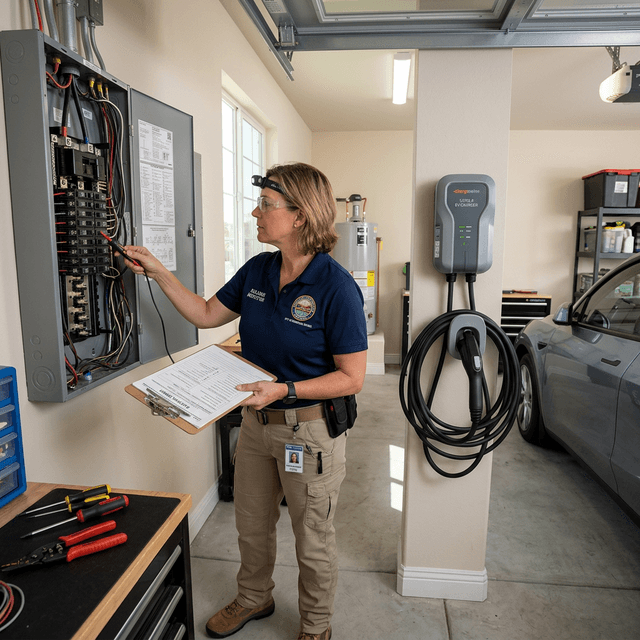
I have been through enough inspections to know exactly what Henderson inspectors check. Here is the inspection checklist they follow:
Electrical Panel
- Breaker size matches wire gauge: 40-amp breaker requires #8 AWG copper minimum. 50-amp breaker requires #6 AWG copper minimum.
- Proper breaker type: The EV circuit needs a double-pole breaker rated for the load.
- Panel labeling: The new breaker must be clearly labeled "EV Charger" on the panel directory.
- Available capacity: Inspector verifies the panel can handle the added load without exceeding its rating.
Wire Run
- Correct wire gauge: Must match the breaker amperage per NEC Table 310.16.
- Conduit protection: Exposed wiring must be in conduit. NM-B (Romex) can only be used inside walls or attics.
- Proper support: Wire and conduit must be supported every 4.5 feet per NEC requirements.
- No splices in walls: All connections must be in accessible junction boxes.
Need a professional installation quote?
Henderson EV Charger Pros handles everything — permits, wiring, and installation. Free estimates, no obligation.
Charger or Outlet Location
- Height: NEMA 14-50 outlets are typically mounted 36-48 inches from the floor.
- GFCI protection: NEC 2023 requires GFCI protection on all 240V receptacles in garages (Section 210.8). This is a common fail point.
- Weatherproof cover: If the charger or outlet is outdoors, it needs an in-use weatherproof cover.
- Clearance: Adequate clearance for the vehicle and charging cable.
Grounding
- Equipment grounding conductor: Must be present and properly sized.
- Bonding: Metal conduit and boxes must be properly bonded.
- Ground rod: If required by local amendment (some Henderson inspections require a supplemental ground rod for detached structures).
Step 3: Common Inspection Fail Points
Based on my experience, these are the top reasons Henderson EV charger inspections fail:
1. Missing GFCI Protection
This is the number one fail point since NEC 2023 took effect. The code now requires GFCI protection on all 240V receptacles in garages. Many DIY installers and even some electricians miss this. You need either a GFCI breaker or a GFCI-protected receptacle.
2. Wrong Wire Gauge
Using #10 AWG on a 40-amp circuit will fail immediately. The wire gauge must match the breaker per NEC tables. I see this most often when homeowners buy wire based on price rather than specification.
3. Improper Conduit Transitions
Where conduit enters the panel or a junction box, you need proper connectors and bushings. Loose conduit fittings are a common inspector call-out.
4. No Panel Directory Update
Every time you add a circuit, you must update the panel directory label. Inspectors will check for this and fail the inspection if it is missing.
5. Insufficient Conductor Fill in Conduit
NEC limits how many conductors you can run through conduit based on the conduit size. Overfilling conduit causes heat buildup and is a code violation.
Step 4: Scheduling the Inspection
Once the installation is complete:
- Call the City of Henderson Inspection Request Line or use their online portal
- Provide your permit number and request an electrical inspection
- Inspections are typically scheduled for the next business day
- You (or your electrician) must be present during the inspection
- The inspector will either pass, pass with conditions, or fail the installation
If You Fail
Do not panic. A failed inspection means you need to correct the noted issues and schedule a re-inspection. Common process:
- Inspector leaves a correction notice listing specific items
- Fix the issues (or have your electrician fix them)
- Schedule a re-inspection (usually free for the first re-inspection)
- The re-inspector only checks the items that were flagged
Step 5: After the Inspection
Once you pass:
- The inspector signs off on the permit
- The City of Henderson closes out the permit as "final"
- You keep a copy of the final inspection for your records
- If you used a licensed electrician, they should provide you with a certificate of completion
Should You Pull the Permit Yourself?
In Nevada, homeowners can pull permits for electrical work on their own property. However, I strongly recommend using a licensed electrician for EV charger installations because:
- A licensed electrician knows current NEC requirements and local Henderson amendments
- They carry insurance that covers any damage during installation
- They handle the entire permit and inspection process
- The work is backed by their license and warranty
At Henderson EV Charger Pros, we handle the complete permit-to-inspection process on every installation. The permit fee is included in our quoted price, and we schedule and attend the inspection on your behalf. Call (838) 205-8397 for a free estimate.
Henderson vs. Clark County Inspections
If you live in an unincorporated area of Clark County rather than within Henderson city limits, the process is similar but goes through the Clark County Department of Building and Fire Prevention instead. The code requirements are the same (NEC 2023), but the permit portal, fees, and inspection scheduling are different.
Not sure if you are in Henderson or Clark County? Check your property tax bill or call us -- we know the jurisdictional boundaries well and can tell you instantly based on your address.
The Bottom Line
Pulling a permit and passing inspection for an EV charger installation in Henderson is straightforward if the work is done correctly. The inspection exists to protect you, your home, and your family. A professional electrician who installs EV chargers regularly will know the current code, handle the paperwork, and pass inspection the first time.
If you want the permit and inspection handled for you, call Henderson EV Charger Pros at (838) 205-8397. We pull the permit, do the work, schedule the inspection, and make sure it passes. That is what we do every day.