
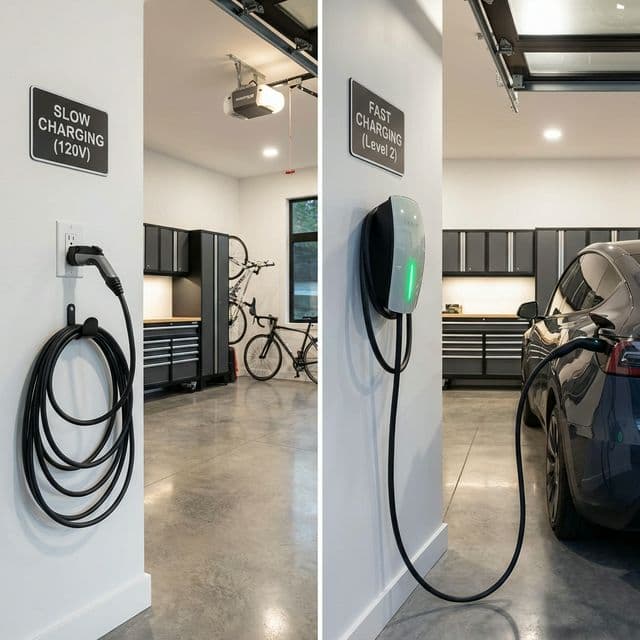
Level 1 vs Level 2 EV Charger: Speed, Cost & What Henderson Homeowners Need
Quick answer: A Level 1 EV charger uses a standard 120V outlet and adds 3-5 miles of range per hour (1.4 kW, 12 amps). A Level 2 EV charger uses a 240V circuit and adds 12-44 miles per hour (3.8-11.5 kW, 16-48 amps). Level 2 costs $500-$2,500 to install but is 5-8x faster and pays for itself through NV Energy off-peak rate savings.
Every EV can charge at two levels at home: Level 1 (standard 120V outlet) and Level 2 (240V dedicated circuit). The speed difference is massive, and it directly affects whether you wake up to a full battery or spend your morning at a public charger. Here in Henderson, where summer heat drains battery efficiency faster, the speed gap matters even more.
What Is Level 1 Charging?
Level 1 charging uses a standard 120-volt household outlet -- the same outlet you plug a lamp into. Every EV ships with a portable charger (called an EVSE) that includes a standard NEMA 5-15 plug for Level 1 use.
Level 1 specs:
- Voltage: 120V AC
- Amperage: 12A on a 15A or 20A circuit
- Power output: ~1.4 kW
- Charging speed: 3-5 miles of range per hour
- No installation required: Plug into any standard outlet
Level 1 is slow. If you drive 40 miles per day, you need 8-13 hours of Level 1 charging just to replace what you used. That eats your entire overnight window, and any disruption (late arrival home, power outage, forgot to plug in) means you start the next day short.
What Is Level 2 Charging?
Level 2 charging uses a 240-volt circuit -- the same voltage as your electric dryer or oven. It requires either a dedicated 240V outlet (like a NEMA 14-50) or a hardwired charging station installed by an electrician.
Level 2 specs:
- Voltage: 240V AC
- Amperage: 16A to 50A (depending on charger and circuit)
- Power output: 3.8 kW to 11.5 kW
- Charging speed: 12-44 miles of range per hour (depending on amperage)
- Requires professional installation: New 240V circuit from your panel
Level 2 is the standard for home EV charging. Most EV owners who charge at home use Level 2 because it replaces a full day's driving in 2-4 hours.
Side-by-Side Comparison
| Feature | Level 1 | Level 2 |
|---------|---------|---------|
| Voltage | 120V | 240V |
| Typical amperage | 12A | 24A - 48A |
| Power output | 1.4 kW | 5.7 - 11.5 kW |
| Miles of range per hour | 3-5 | 12-44 |
| Time to add 40 miles | 8-13 hours | 1-3 hours |
| Time to full charge (60 kWh) | 40-50 hours | 5-10 hours |
| Installation cost | $0 | $500-$2,500 |
| Equipment cost | $0 (included with car) | $0-$900 |
| Outlet type | NEMA 5-15 (standard) | NEMA 14-50 or hardwired |
| Permit required | No | Yes |
| Works in any home | Yes | Requires 240V circuit |
At Henderson EV Charger Pros, we handle the full Level 2 installation process -- permits, wiring, and charger mounting. Call (838) 205-8397 or fill out the form on our homepage for a free estimate.
Charging Speed: Real-World Numbers
Here is how long each level takes to charge popular EVs from 20% to 80% (the most common daily charging window):
Tesla Model 3 Long Range (~75 kWh battery)
- Level 1: ~30 hours
- Level 2 (32A): ~6 hours
- Level 2 (48A): ~4 hours
Tesla Model Y (~75 kWh battery)
- Level 1: ~32 hours
- Level 2 (32A): ~6.5 hours
- Level 2 (48A): ~4.5 hours
Chevrolet Equinox EV (~85 kWh battery)
- Level 1: ~36 hours
- Level 2 (32A): ~7 hours
- Level 2 (48A): ~5 hours
Hyundai Ioniq 5 (~77 kWh battery)
- Level 1: ~33 hours
- Level 2 (32A): ~6.5 hours
- Level 2 (48A): ~4.5 hours
Level 2 is 5-8 times faster than Level 1. At any amperage, Level 2 will fully charge virtually any EV overnight. Level 1 often cannot finish in that window.
Cost Comparison
Level 1: $0 Upfront
You plug your car's included charger into an existing outlet. The only cost is electricity.
Electricity cost per charge (NV Energy residential rates, ~$0.12/kWh):
- 40 miles of charging: ~$1.50-$2.00
- Full charge (60 kWh): ~$7.20
Level 2: $500-$2,500 Upfront
Level 2 requires a dedicated 240V circuit installed by a licensed electrician:
- NEMA 14-50 outlet only (use your portable charger): $350-$900
- Dedicated wall charger (ChargePoint, Tesla, etc.): $800-$2,500
- With panel upgrade: $2,500-$5,500
Electricity cost per charge (same rates):
Need a professional installation quote?
Henderson EV Charger Pros handles everything — permits, wiring, and installation. Free estimates, no obligation.
- 40 miles of charging: ~$1.50-$2.00
- Full charge (60 kWh): ~$7.20
The electricity cost is identical -- you are putting the same energy into the battery either way. Level 2 just does it faster. The real financial advantage of Level 2 is access to NV Energy's time-of-use rates. Off-peak electricity (10 PM - 6 AM) is 30-50% cheaper. A Level 2 charger can finish a full charge in that window; Level 1 cannot always do that.
Long-Term Savings
If NV Energy's TOU rates save you $0.04/kWh and you charge 30 kWh per day:
- Daily savings: $1.20
- Monthly savings: $36
- Annual savings: $432
A $1,000 Level 2 installation pays for itself in under 2.5 years through off-peak rate savings alone.
Installation Requirements
Level 1: No Installation
- Plug into any standard 120V outlet
- Use a dedicated 20A circuit if possible (sharing with other appliances trips breakers)
- Use a grounded, three-prong outlet in good condition
- Never use extension cords -- plug the portable charger directly into the wall
Level 2: Professional Installation Required
A Level 2 installation in Henderson involves:
1. Load calculation: We verify your panel can support the additional circuit
2. Permit: City of Henderson electrical permit ($75-$150)
3. Circuit installation: Running 240V wiring from your panel to the charging location
4. Charger mounting or outlet installation: Hardwired unit or NEMA 14-50 outlet
5. Inspection: City inspector verifies NEC compliance
6. Timeline: 5-8 business days from permit to inspection
Panel upgrade: If your panel is 100A or has no open slots for a new 240V breaker, you need a panel upgrade ($1,800-$3,500) before the charger goes in.
When Level 1 Charging Is Enough
Level 1 works if all of these apply to you:
- You drive under 30-40 miles per day: Level 1 can replace this overnight (10-13 hours)
- You have a plug-in hybrid (PHEV): PHEVs have small batteries (8-18 kWh) that Level 1 charges in 6-12 hours
- You have 10-12 hours of plug-in time every night: Consistent, uninterrupted
- You have a backup plan: Access to public Level 2 or DC fast charging when Level 1 falls short
- You are renting and cannot modify the property: Level 1 is your only option without landlord approval
Where Level 1 works:
- Short commuter: 20-mile round trip, plugs in at 5 PM, car is full by 11 PM
- Light driver: 15-20 miles per day for errands, charges overnight
- PHEV owner: Chevy Volt, Toyota RAV4 Prime, or similar with 30-50 mile electric range plus gas backup
Where Level 1 fails:
- Daily commute over 50 miles: Level 1 cannot keep up day after day
- Multi-EV household: One Level 1 outlet for two EVs does not work
- Irregular schedule: If you cannot plug in for 10+ hours consistently, you fall behind
- Henderson summer heat: Heavy AC use reduces efficiency, meaning more range consumed per mile and more charging needed
- Weekend road trip returns: Low battery Sunday night, need a full charge by Monday morning
When You Need Level 2
You need Level 2 if any of these are true:
- You drive more than 40 miles per day
- You own a battery-electric vehicle (BEV) with a battery over 40 kWh
- You cannot guarantee 10+ hours of charge time every night
- You want to charge quickly when you need it
- You have multiple EVs
- You want NV Energy's TOU rate savings by scheduling charging windows
- You do not want to think about charging -- plug in, walk away, it is done
For BEV owners in Henderson, Level 2 is essential. You come home, plug in, and your car is ready in 2-4 hours. Charging stops being something you manage and becomes something that just happens.
Level 1 vs Level 2 vs Level 3 EV Chargers
Here is how all three EV charging levels compare:
| Spec | Level 1 | Level 2 | Level 3 (DC Fast) |
|------|---------|---------|-------------------|
| Voltage | 120V AC | 240V AC | 400-900V DC |
| Amperage | 12A | 16-48A | 100-500A |
| Power (kW) | 1.4 kW | 3.8-11.5 kW | 50-350 kW |
| Miles per hour | 3-5 | 12-44 | 200-1,000 |
| 20-80% charge time | 30-50 hours | 3-10 hours | 20-45 minutes |
| Installation cost | $0 | $500-$2,500 | $50,000-$150,000+ |
| Home use | Yes | Yes | No |
Level 3 / DC Fast Charging (Tesla Superchargers, Electrify America) is not available for home installation -- it requires commercial-grade 480V three-phase power and costs $50,000+. Level 3 is for road trips and public charging. Henderson's DC fast charging network is growing along major corridors, but daily charging should happen at home with Level 1 or Level 2.
How many amps and kW does a Level 2 charger use?
A Level 2 EV charger draws between 16 and 48 amps at 240 volts, producing 3.8 to 11.5 kW of power. The most common home setups:
- 24A charger on 30A breaker: 5.7 kW, ~20 miles/hour
- 32A charger on 40A breaker: 7.7 kW, ~30 miles/hour (NEMA 14-50 setup)
- 40A charger on 50A breaker: 9.6 kW, ~37 miles/hour
- 48A charger on 60A breaker: 11.5 kW, ~44 miles/hour (Tesla Wall Connector and similar)
The circuit breaker must be rated at 125% of the charger's continuous draw per NEC code. A 48-amp charger requires a 60-amp breaker. Your electrician handles this sizing during the permit and installation process.
Our Recommendation for Henderson Homeowners
If you own a battery-electric vehicle, install Level 2. The $800-$2,500 investment changes your EV ownership completely. Full charge every morning, lower electricity costs with off-peak rates, and zero range anxiety.
If you have a plug-in hybrid, Level 1 is likely sufficient. PHEVs have small batteries that Level 1 handles overnight, and the gas engine covers any gaps.
If you are renting and cannot install Level 2, Level 1 works as a stopgap. Talk to your landlord about a Level 2 installation -- it increases property value and Nevada law (NRS 278.0208) supports tenants' rights to install EV chargers.
Frequently Asked Questions
How much does a Level 2 charger installation cost in Henderson?
A standard Level 2 installation runs $800-$2,500, covering the charger, labor, materials, and City of Henderson permit. If your home needs a panel upgrade, the total reaches $3,500-$5,500. The federal tax credit covers 30% of the cost up to $1,000.
Can I use Level 1 charging for a Tesla Model Y?
You can, but a Model Y needs about 32 hours of Level 1 charging to go from 20% to 80%. If you drive 40+ miles per day, Level 1 will not keep up. For anything beyond light daily use, Level 2 is necessary.
Does Level 2 use more electricity than Level 1?
No. Both levels put the same amount of energy into your battery. Level 2 is just faster. Your electricity bill is the same for the same amount of driving, but Level 2 makes it easier to charge during off-peak hours when rates are 30-50% lower.
Do I need an electrician to install a Level 2 charger?
Yes. Level 2 requires a new 240V circuit from your electrical panel, which must be installed by a licensed electrician and inspected by the city. The City of Henderson requires an electrical permit for this work.
How long does Level 2 installation take?
The physical installation takes 2-4 hours. With permit approval and inspection, the full process runs 5-8 business days. We handle the permit, installation, and inspection scheduling as one package.
How many amps is a Level 2 EV charger?
Level 2 EV chargers range from 16 to 48 amps. The most common home installations use 32A (NEMA 14-50 outlet) or 48A (hardwired wall charger). Higher amps means faster charging -- a 48A charger adds 44 miles of range per hour compared to 30 miles per hour for a 32A charger.
How many kWh does a Level 2 charger use?
A Level 2 charger produces 3.8 to 11.5 kW of power depending on the amperage. To fully charge a 60 kWh battery, you will use approximately 60 kWh of electricity (plus about 10-15% lost to charging inefficiency). At NV Energy's residential rate of ~$0.12/kWh, a full charge costs about $7-$8.
How fast can a Level 2 charger charge?
The fastest Level 2 home chargers operate at 48 amps / 11.5 kW and add 44 miles of range per hour. A Tesla Model 3 Long Range charges from 20% to 80% in about 4 hours at this speed. A 32-amp charger (like a NEMA 14-50 setup) adds 30 miles per hour and takes about 6 hours for the same charge.
What is a Level 1 EV charger wattage and amperage?
A Level 1 EV charger operates at 120 volts and draws 12 amps, producing approximately 1.4 kW (1,400 watts) of power. This is the charger that comes free with most new EVs. It plugs into any standard household outlet but only adds 3-5 miles of range per hour.
Can I use a portable Level 1 EV charger?
Yes. Every new EV comes with a portable Level 1 charger that plugs into a standard 120V outlet. Many of these portable chargers also include a NEMA 14-50 adapter for Level 2 speeds when you have a 240V outlet. The portable charger is convenient for travel but much slower than a dedicated Level 2 wall charger for daily home use.
Ready to get your charger installed? Henderson EV Charger Pros offers free on-site assessments. We'll inspect your panel, recommend the right charger, and give you a fixed-price quote -- no surprises. Call (838) 205-8397.
Disclaimer: Charging speeds and times in this article are approximate and vary based on vehicle model, battery condition, temperature, and other factors. Costs reflect typical Henderson, NV pricing as of early 2026. This article is for informational purposes only and does not constitute professional advice. Consult a licensed electrician to determine the best charging solution for your specific needs.