
EV Charger Installation for Older Henderson Homes (Pre-2000 Builds)
Henderson has a lot of homes built in the 1980s and 1990s. Green Valley, original Henderson, and parts of the Water Street corridor were developed when a 100-amp electrical panel was standard, garages had a single 15-amp circuit, and nobody was thinking about plugging in a car. Installing an EV charger in these older homes is often different from a newer build. Here is what homeowners should know.
The Electrical Reality of Pre-2000 Henderson Homes
100-Amp or 125-Amp Panels
Most Henderson homes built before 2000 have 100-amp or 125-amp main panels. A Level 2 EV charger draws 40-50 amps on a dedicated circuit. When you add that to your existing air conditioning (which can draw 40-60 amps alone in Henderson summers), water heater, kitchen appliances, and general loads, a 100-amp panel simply does not have enough capacity.
The math: If your panel is 100 amps and your existing loads total 75-85 amps (common for a 3-bedroom Henderson home with central AC), adding a 40-amp EV circuit puts you at 115-125 amps. That exceeds your panel rating.
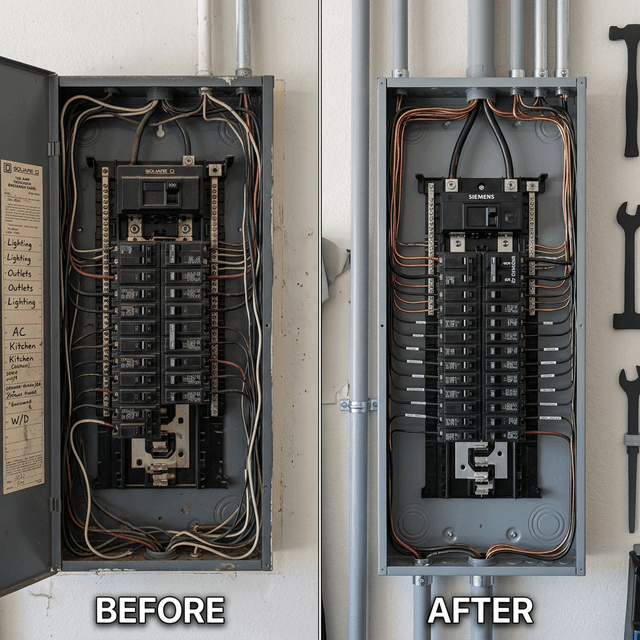
The solution: A panel upgrade from 100A to 200A. This gives you the headroom for EV charging, future solar panels, and any other electrical additions.
Older Panel Brands
Some Henderson homes from the 1970s-1990s have electrical panels that are known safety hazards:
Federal Pacific Electric (FPE) Stab-Lok panels: These panels have a well-documented history of breakers failing to trip during overloads. If you have an FPE panel, it is commonly recommended that it be replaced regardless of whether you are adding an EV charger, and certainly before adding any significant electrical load.
Zinsco panels: Similar issues to FPE. The breakers can overheat and melt to the bus bar, creating a fire risk. Another panel that is commonly recommended for replacement.
GTE/Sylvania panels: Less dangerous than FPE or Zinsco, but parts are no longer manufactured, making it difficult to add new breakers for an EV circuit.
If you have any of these panels, a panel upgrade is generally treated as a safety necessity rather than an option. Ask a licensed electrician to evaluate it.
Aluminum Wiring
Some Henderson homes from the late 1960s to early 1970s used aluminum wiring for branch circuits. Aluminum wiring itself is not inherently dangerous, but it requires special handling:
- Connections must use CO/ALR rated devices and connectors
- Junctions must be properly torqued
- New EV charger circuits are typically wired with copper rather than aluminum
If your home has aluminum wiring, a qualified installer should note it during the assessment and advise on any remediation needed in the areas they will work in.
Common Challenges by Henderson Neighborhood
Green Valley (1980s-1990s Builds)
Green Valley is one of Henderson's largest older neighborhoods, and many of its homes fit the profile below.
Typical setup: 100-125 amp panel, attached 2-car garage, panel located in the garage or on the exterior wall near the garage.
Common challenges:
- Panel is at capacity with AC, pool pump, and kitchen remodel additions
- Panel may be on the opposite side of the garage from the ideal charger location
- HOA restrictions on exterior conduit routing
Typical solution: Panel upgrade to 200A + dedicated 40-50 amp EV circuit. Typical range reported for Nevada installs: $2,300-$4,000 including the charger installation; your quote will vary.
Original Henderson / Water Street Area (1950s-1970s Builds)
The oldest homes in Henderson, near downtown and Water Street.
Typical setup: 60-100 amp panel, small detached or attached single-car garage, panel inside the house.
Common challenges:
Need a professional installation quote?
Get matched with a qualified local installer for a written quote. Free, no obligation.
- Very limited panel capacity (sometimes 60 amps)
- Long wire runs from the panel inside the house to the garage
- Older wiring throughout the home (some aluminum)
- Narrow garages that make charger placement tricky
Typical solution: Panel upgrade to 200A (often including a new meter base) + long circuit run with appropriate conduit. Typical range reported for Nevada installs: $3,000-$5,500 due to the longer wire runs and panel age; your quote will vary.
MacDonald Ranch / Seven Hills (1990s-2000s Builds)
These homes are on the newer end of "older" and generally have fewer challenges.
Typical setup: 150-200 amp panel, 2-3 car garage, panel in the garage.
Common challenges:
- Panel may have limited open breaker spaces despite higher amperage
- Long driveway homes may want the charger outside the garage
- Custom homes with unique electrical configurations
Typical solution: Often just a dedicated circuit without a panel upgrade. Typical range reported for Nevada installs: $500-$1,500 for the charger installation only; your quote will vary.
The Assessment: What an Installer Should Check in Older Homes
When assessing an older Henderson home for EV charger installation, an installer typically checks:
1. Panel Capacity and Condition
- Main breaker amperage rating
- Panel brand and model (checking for recalled brands)
- Number of open breaker spaces
- Condition of the bus bars, breakers, and connections
- Load calculation (NEC Article 220) to determine available capacity
2. Existing Wiring
- Wire types used (copper vs aluminum)
- Condition of the service entrance cables
- Grounding system condition
- Any signs of overheating, corrosion, or damage
3. Circuit Route
- Distance from the panel to the charger location
- Obstacles in the path (walls, ceilings, attic, exterior)
- Best conduit routing for clean installation
- Whether the route stays inside the garage or goes through other spaces
4. Garage Layout
- Where the vehicle's charge port sits when parked
- Best mounting location for the charger
- Cable management for a clean setup
- Ventilation (relevant for older garages without insulation)
5. NV Energy Service
- Meter base condition (older meters may need replacement during an upgrade)
- Service entrance cable condition
- Whether NV Energy coordination is needed for a panel upgrade
Cost Breakdown for Older Homes
Here are typical ranges reported for Nevada installs of EV chargers in older homes compared to newer ones; your quote will vary:
Newer Home (200A Panel, Short Run)
- Charger installation only: $500-$1,200
- No panel upgrade needed
- 2-4 hour installation
Older Home (100A Panel, Standard Run)
- Panel upgrade: $1,800-$3,500
- Charger installation: $500-$1,200
- Combined total: $2,300-$4,500
- Full day installation
Older Home (60-100A Panel, Long Run)
- Panel upgrade + new meter base: $2,500-$4,000
- Long circuit run (30+ feet): $800-$1,800
- Combined total: $3,300-$5,500
- 1-2 day installation
Some installers offer package pricing when a panel upgrade is bundled with the charger installation; ask whether your quote reflects any savings versus doing them as separate projects.
The Panel Upgrade Process
Since many older Henderson home EV installations require a panel upgrade, here is what the process commonly looks like:
Day 1: Panel Upgrade
- NV Energy disconnects power at the meter
- The installer removes the old panel
- Install the new 200-amp panel and main breaker
- Reconnect all existing circuits to the new panel
- Add the new 40-50 amp EV charger circuit
- NV Energy reconnects power
- Power outage duration: 6-8 hours
Same Day or Day 2: Charger Installation
- Mount the EV charger or NEMA 14-50 outlet
- Run the circuit from the new panel to the charger location
- Install conduit, wire, and connectors
- Test the complete system
- Schedule the City of Henderson inspection
Inspection
- Scheduled 1-2 business days after installation
- Inspector checks both the panel upgrade and charger circuit
- Your installer typically coordinates and attends the inspection; confirm this in your quote
Financing and Incentives
A panel upgrade plus EV charger installation is a significant investment for older homes. Some installers offer financing or package pricing; ask about it when you compare quotes. You may also qualify for:
- Federal 30C tax credit: Expired for installs placed in service after June 30, 2026 -- previously up to $1,000 for residential EV charger installation, no longer available for a new project
- NV Energy rebates: Check current residential EV programs
- Local utility programs: Time-of-use rate plans that reduce charging costs
Get Your Older Home Assessed
If you own an older Henderson home and want to install an EV charger, start with an on-site assessment by a licensed installer. That assessment is what determines what your home needs, what it will cost, and how long it will take. Ask for a written, itemized quote.
Older homes need an installer who is comfortable with their quirks. Request a free installation estimate and we'll match you with a qualified local installer. Ask them to confirm the permit, load calculation, and workmanship warranty in writing.