
Workplace & Fleet EV Charging: What Henderson Businesses Need to Know
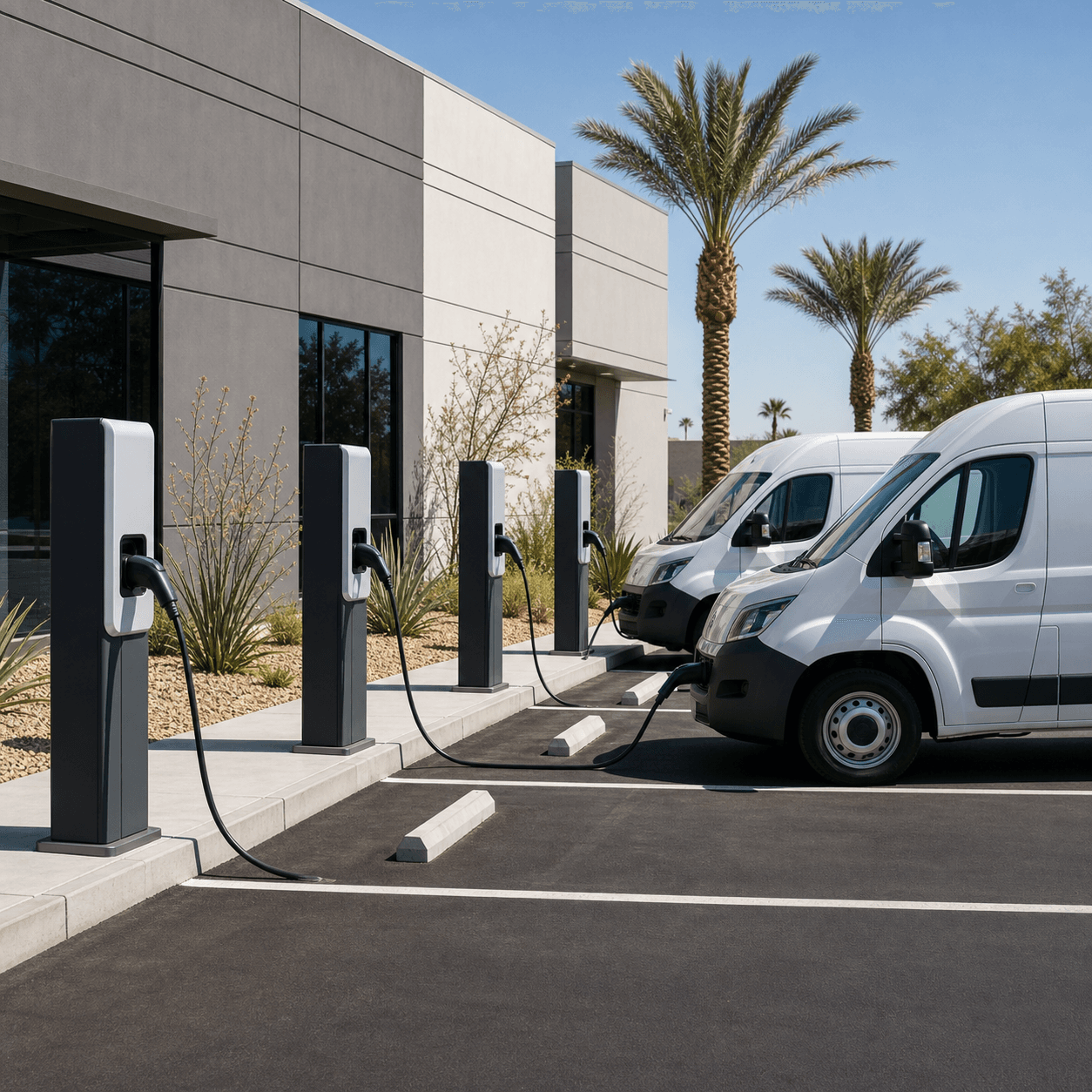
More Henderson businesses are adding EV charging — some for employee benefits, some because their own delivery or service fleet is going electric, and some to attract EV-driving customers. These are three different problems with three different solutions. This guide breaks down what each one actually requires and costs.
The Three Use Cases
1. Employee/workplace charging — A handful of stations for staff to charge during the workday. Lower daily utilization, simpler load profile, often the easiest to justify with NV Energy rebates.
2. Fleet charging — Charging your own company vehicles (delivery vans, service trucks, sales fleet) overnight or between shifts. Requires planning around your specific fleet size and route schedules.
3. Customer-facing charging — Stations meant to attract EV-driving customers to a retail, hospitality, or office location. Usually paired with payment processing and public-facing signage.
Many Henderson businesses end up needing a mix, and the electrical infrastructure often overlaps — which is why planning station count and load management correctly from the start matters more than for a typical residential install.
Step 1: How Many Stations Do You Actually Need?
This is often the most important planning question for businesses, because overbuilding wastes money and underbuilding means a second construction project in two years.
For employee/workplace charging:
A reasonable starting ratio is 1 station per 15-20 employees who commute by car, assuming most stations turn over once or twice during a workday (someone charges in the morning, another employee midday). Businesses expecting rapid EV adoption among staff often plan for 1 per 10 as a longer-term target, but phase installation in two stages rather than building it all at once.
For fleet charging:
This is driven entirely by your fleet size and schedule, not a rule of thumb. A delivery fleet of 8 vans that all return to base overnight needs enough stations and total electrical capacity to fully charge all 8 within your overnight window — but with load management (see below), you often need far fewer physical stations than vehicles.
For customer-facing charging:
2-4 stations is typical for most retail and hospitality locations. More than that rarely improves customer draw meaningfully unless you're specifically positioning as an EV-charging destination.
Step 2: Load Management Changes the Math
The biggest cost lever in commercial EV charging is whether you install "dumb" independent circuits for each station, or a load-managed system that shares available electrical capacity across multiple stations intelligently.
Without load management: Each station needs its own full-capacity circuit sized for worst-case simultaneous use. For an 8-vehicle fleet, this can mean sizing for 8 stations charging at full power at once — expensive, and often requires a service upgrade.
With load management: The system dynamically allocates available amperage across active stations, slowing individual charge rates when multiple vehicles are plugged in simultaneously, and speeding back up as vehicles finish. This lets you serve significantly more vehicles on the same electrical service.
Need a professional installation quote?
Get matched with a qualified local installer for a written quote. Free, no obligation.
For most fleet and multi-station workplace installs, load management pays for itself by avoiding a costly utility service upgrade. Ask a commercial installer whether their site survey includes a load analysis to determine whether it's the right call for your situation.
Installation Cost in Henderson (2026)
The ranges below are typical ranges reported for Nevada installs; your quote will vary.
Single Employee Charging Station (Existing Electrical Capacity)
- Station hardware: $700-$1,500
- Circuit, conduit, labor: $800-$1,800
- Commercial electrical permit: $150-$350
- Typical total installed: $1,650-$3,650 per station
Multi-Station Workplace Install (4-8 Stations, With Load Management)
- Station hardware (4-8 units): $4,000-$12,000
- Load management controller, shared circuit infrastructure, labor: $6,000-$18,000
- Permits and inspections: $500-$1,200
- Total installed: $10,500-$31,200, typically $2,000-$4,500 per station effective cost — meaningfully cheaper per station than standalone circuits
Fleet Depot Charging (6-15 Vehicles, Overnight Charging)
- Station hardware: varies by count and power level needed
- Load management system, sized for overnight charging window: $8,000-$25,000
- Electrical service assessment and potential utility coordination
- Permits: $500-$1,500
- Total installed: typically $25,000-$75,000+ depending on fleet size, existing electrical service capacity, and whether a utility service upgrade is required
If a Utility Service Upgrade Is Needed
Larger fleet or multi-station projects sometimes require NV Energy to upgrade the site's electrical service. This adds significant timeline (NV Energy coordination alone can take 4-8 weeks) and cost, which is why a load analysis during the site survey is one of the most important steps — it helps determine whether you can avoid this entirely.
NV Energy Commercial Rebates
NV Energy offers commercial EV charging rebates that can offset a meaningful share of installation costs for qualifying businesses, particularly for workplace charging and make-ready electrical infrastructure. Rebate structures and availability change periodically, so confirm current program status with NV Energy and ask your installer what your specific project may qualify for, rather than relying on a number that may be outdated by the time you're ready to install.
Timeline
- Single station, existing capacity: 1-2 weeks from site visit to completed install
- Multi-station workplace install: 3-6 weeks including permits and load management setup
- Fleet depot with utility coordination: 2-4 months, driven primarily by NV Energy service upgrade timelines when required
Henderson-Specific Considerations
Summer heat and fleet scheduling: Outdoor-mounted commercial stations need NEMA 3R weatherproof rating as standard in Henderson's climate — not an upgrade, a baseline expectation that commercial quotes should account for.
Permitting: Commercial installs go through City of Henderson (or Clark County, depending on exact location) commercial electrical permitting, which is a more involved process than residential — expect more detailed load calculation review from the inspector, particularly for fleet-scale projects.
Frequently Asked Questions
How many EV chargers does my business actually need?
For employee charging, start with roughly 1 station per 15-20 car-commuting employees. For fleet charging, it's driven by your fleet size and overnight charging window rather than a fixed ratio — an installer typically calculates this during the site survey.
Is load management worth the extra cost?
For any install with 4+ stations or a fleet-scale project, almost always yes — it typically avoids a costly utility service upgrade and reduces the effective cost per station.
Do we need a utility service upgrade for fleet charging?
Sometimes, depending on your existing electrical service size and fleet charging needs. Ask your installer to include a load analysis in the site survey to answer this before you commit to a project scope.
Does NV Energy offer rebates for commercial EV charging?
Yes, NV Energy has commercial EV charging incentive programs, though specific terms change periodically. Confirm current program status with NV Energy and ask your installer what your project may qualify for.
Planning workplace or fleet EV charging for your Henderson business? Request a free estimate and get matched with a local commercial installer who can survey the site, run a load analysis, and identify rebates.
Disclaimer: Educational content only. Actual station counts, load management requirements, and costs depend on your specific site's electrical service, fleet composition, and local permitting requirements. Always work with a licensed electrician for commercial EV charging installation.