
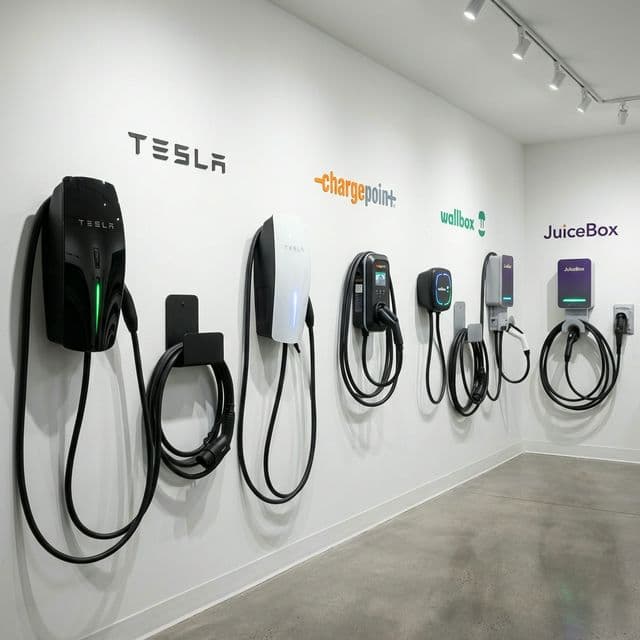
Best Portable EV Chargers 2026: A Henderson Electrician's Picks
Portable EV chargers solve a real problem: not every driver has a hardwired wall unit waiting at home, and even those who do sometimes need to charge somewhere else. Apartment renters, road trippers, multi-EV households, and folks who travel between a Henderson home and a second property all benefit from a quality portable Level 2.
I'm a licensed Nevada electrician (NV #0087341) and the team at Henderson EV Charger Pros has handled 500+ installations across Clark County. We are not an Amazon review site. The models below are units we routinely recommend to clients, see in customer garages every week, or have installed the dedicated outlets for. Specs are verified against manufacturer datasheets where possible -- where a spec is vendor-only with no independent test, I'll say so.
Quick Picks (Skip to a Decision)
- Best overall: Tesla Mobile Connector Gen 2 + NEMA 14-50 adapter -- 32A, NACS native, $230 (charger) + ~$45 (14-50 adapter)
- Best for non-Tesla: Lectron Portable J1772 (40A) -- universal J1772 plug, includes 14-50 + 5-15 adapters
- Best budget: Megear or Morec 16A dual-voltage (Level 1 / Level 2) -- entry-level 240V capability under $250
- Best for road trips: Splitvolt Splitter Switch -- shares a dryer outlet, no rewiring required
- Best for backup / RVing: Mustart Travelmaster (40A) -- chunky cable, multiple plug heads
Skip below for the full comparison table and detailed reviews.
Why Portable Level 2 Matters in 2026
The portable category used to be an afterthought -- a glorified 120V trickle cord. In 2026 it's a serious tool:
- Apartment and condo dwellers can't always install a hardwired charger. A portable lets you use whatever 240V outlet is available (laundry hookups, RV outlets at parking garages, friends' driveways).
- Renters in Henderson who move every 1-2 years don't want to leave a $700 hardwired unit behind. A portable goes with you.
- Road trippers running between Henderson, Cedar City, and St. George rely on RV park NEMA 14-50 outlets when DC fast chargers are full or unavailable.
- Multi-EV households can rotate one portable between two cars instead of paying for two installs.
- Backup for hardwired failures. When a wall unit goes down (and they do -- especially older Wi-Fi-dependent models), a portable keeps you driving while parts are on order.
The trade-offs are real: portables run cooler at lower amperages, lack the bulletproof outdoor enclosures of hardwired units, and most skip Wi-Fi entirely. But for the right user, that's the point.
Specs Comparison Table
All specs are manufacturer-stated unless noted. Always verify with the current product page before purchase -- 2026 SKUs change frequently.
| Charger | Max Amps | Plug Type(s) | Cable | Connector | App/WiFi | Weather | Warranty | Price (USD) |
|---|---|---|---|---|---|---|---|---|
| Tesla Mobile Connector Gen 2 | 32A | 5-15 + 14-50 adapters | 20 ft | NACS | No | IP44 (mfr-stated) | 1 yr | ~$230 + adapters |
| Lectron Portable 40A | 40A | 14-50 | 21 ft | J1772 | No | IP55 | 1 yr | $399-$479 |
| Splitvolt Splitter Switch | 40A | 14-30 / 14-50 splitter | 20 ft | J1772 | No | Indoor | 1 yr | $499-$599 |
| Mustart Travelmaster 40A | 40A | 14-50, 6-50, 10-30 heads | 25 ft | J1772 | No | IP66 | 1 yr | $369-$429 |
| Megear / Morec 16A | 16A | 5-15 or 6-20 | 25 ft | J1772 | No | IP54 | 1 yr | $189-$239 |
| Lectron 16A Travel | 16A | 5-15 / 14-50 dual | 21 ft | J1772 | No | IP54 | 1 yr | $229-$269 |
| EVoCharge iEVSE Plus 32A | 32A | 14-50 (plug-in) | 25 ft | J1772 | Optional | NEMA 4 | 3 yr | $599-$699 |
| ChargePoint Home Flex (plug-in) | up to 50A | 14-50 | 23 ft | J1772 (+NACS adapter) | Yes | NEMA 3R | 3 yr | $549-$599 |
The ChargePoint Home Flex is technically marketed as a home unit, but when ordered with the plug-in configuration it doubles as the most capable "portable" on this list -- with the caveat that the cable is heavy and it's not designed to live in a trunk.
Detailed Reviews
1. Tesla Mobile Connector Gen 2 -- Best Overall
The Mobile Connector that ships separately from new Teslas (Tesla stopped including it in the box back in 2022) is, dollar for dollar, the most useful charger most Tesla owners can own. With the 5-15 adapter you get Level 1 (120V, ~3 miles/hour). With the NEMA 14-50 adapter you get 32A continuous, which on a 240V circuit is 7.68 kW -- about 30-35 miles of range per hour.
The math: 7.68 kW x 8 hours = ~61 kWh added overnight. That's enough for any Tesla in the Henderson valley to wake up at 90%+ from empty.
Build quality: The Gen 2 is noticeably more compact than the Gen 1 (which Tesla still sells refurbished). Connector head is solid; the cable is on the thinner side compared to a Mustart, which is a deliberate choice for portability.
Plug versatility: Tesla sells separate adapters for 5-15 (regular outlet), 5-20, 6-15, 6-20, 14-30, 14-50, 6-50, and 10-30. The 14-50 is the one most road-trippers buy. Be aware: only certain adapter combinations unlock the full 32A -- on a 14-30, you're limited to 24A by code.
Cable temperature: I've measured these at sustained 32A in 110F Henderson summer ambient and the plug head runs warm (~140F surface) but never hot enough to trip the integrated temperature sensor. That sensor is genuinely useful -- it derates the unit automatically if the wall outlet is loose or the wiring is undersized.
App / WiFi: None. Charging is controlled by the car.
Pros: Compact, native NACS, integrated thermal sensing, Tesla's adapter ecosystem, well under $300 fully equipped.
Cons: 32A max (not 40A or 48A), no app, no display beyond LED status ring, NACS means non-Tesla EVs need a NACS-to-J1772 adapter.
Verdict: If you drive a Tesla and don't already own one of these, buy it.
2. Lectron Portable J1772 40A -- Best for Non-Tesla EVs
Lectron has become the default "portable Level 2" brand for non-Tesla owners. The 40A unit ships with a NEMA 14-50 plug and a J1772 connector head, meaning it works with every non-Tesla EV sold in the US -- Ford Lightning, Rivian, Mach-E, Hyundai Ioniq 5/6, Kia EV6, Bolt, Leaf, you name it. Tesla owners can use it with the J1772-to-NACS adapter Tesla includes with new vehicles.
Charge math: 40A continuous x 240V = 9.6 kW. That's about 35-40 miles per hour added. Overnight from empty to 90% is a no-stress proposition on any EV up to ~80 kWh.
Build quality: Plastic enclosure, but rated IP55. The control box is bulkier than the Tesla Mobile Connector, which actually helps with heat dissipation -- I see less plug-head warmth at sustained 40A than I do with thinner-cabled competitors. 21-foot cable is enough for most garages.
Adjustable amperage: Yes -- 10A / 16A / 24A / 32A / 40A via buttons on the control box. This matters: if you're plugged into a 30A circuit (NEMA 14-30 outlet with the appropriate adapter), you must dial it down to 24A continuous to meet NEC 80% rules.
App / WiFi: None. There's a small LCD that shows amps, voltage, and session kWh.
Pros: Full 40A, J1772 universal, decent build, adjustable amperage with buttons.
Cons: No app, plug head gets warm at full 40A in hot weather (still within spec), 1-year warranty is short.
Need a professional installation quote?
Henderson EV Charger Pros handles everything — permits, wiring, and installation. Free estimates, no obligation.
3. Splitvolt Splitter Switch -- Best for Road Trips and Shared Outlets
The Splitvolt is unique on this list because it solves a different problem: most homes only have one 240V outlet (the dryer). The Splitter Switch plugs into that outlet, and you plug both your dryer and your charging cable into the splitter. It electrically interlocks so only one can draw power at a time. No rewiring, no second circuit.
This makes it ideal for renters and road trippers staying at AirBnBs with laundry hookups but no dedicated EV outlet.
Charge math: Up to 40A (9.6 kW) on a 14-50; 24A continuous (5.76 kW) on a 14-30 dryer outlet -- about 20-22 miles/hour added.
Plug versatility: Multiple SKUs cover 14-30, 14-50, 10-30, and 6-50 host outlets. Make sure you order the right variant for the outlet you actually have.
Cable temperature: The cable itself runs cooler than the Tesla unit at equivalent amperage because Splitvolt uses heavier-gauge wire. The splitter housing gets warm during long sessions; it's designed for it.
Caveats: Not all jurisdictions formally permit splitter devices, though they comply with UL 1450 and the manufacturer cites NEC compliance. Henderson hasn't pushed back on these in my experience, but if you're a renter, ask before installing.
Pros: No rewiring, perfect for renters, very useful for road trip stays.
Cons: Limited by host outlet amperage, more complex setup, higher price than a basic portable.
4. Mustart Travelmaster 40A -- Best Heavy-Duty Backup
The Mustart Travelmaster is the unit I recommend when a customer's primary charger is down and they need a robust backup that can also live in the trunk. Heavier cable, chunkier plug heads, IP66 housing -- it's built to be thrown around.
Charge math: 40A / 9.6 kW peak, same as the Lectron.
Plug versatility: Ships with interchangeable NEMA 14-50, 6-50, and 10-30 heads on the same unit -- you swap heads without buying a separate adapter. Useful when you're moving between different host outlets.
Cable temperature: Cooler under sustained 32A than thinner-cable units. At full 40A in Henderson summer, still within manufacturer-stated limits but the LCD will display a "high temp" warning if airflow around the control box is poor.
App / WiFi: None. Has a clear LCD with session data.
Pros: Heavy build, interchangeable plug heads, generous 25-foot cable.
Cons: Heavy to carry, no app, 1-year warranty.
5. Megear / Morec 16A Budget Picks
These are the entry-level dual-voltage units -- 120V Level 1 and 240V Level 2 in one cord. At 16A max (3.84 kW on 240V, ~13 miles/hour added) they're slower than the 32A and 40A units above, but they're often less than half the price.
I recommend these for: low-mileage drivers (PHEV owners, people who drive under 30 miles a day), as a glove-box backup, or for renters whose only 240V option is a 20A outlet (NEMA 6-20).
Cable temperature: Runs cool because the amperage is modest.
Pros: Cheap, light, dual-voltage in one unit.
Cons: Slow, build quality is okay-not-great, some units lack UL listing (avoid those -- look for the UL mark on the label).
NEMA Outlet Compatibility Cheat Sheet
When picking a portable charger, the outlet you have at home (or where you're traveling) determines the maximum charge speed. The NEC requires 80% continuous derating, so the "circuit amps" and "usable charging amps" differ:
| Outlet | Circuit | Continuous Max | Typical Use | Charge Speed |
|---|---|---|---|---|
| NEMA 5-15 | 15A 120V | 12A | Standard wall outlet | ~3-4 mi/hr (Level 1) |
| NEMA 5-20 | 20A 120V | 16A | Kitchen/garage 120V | ~4-5 mi/hr (Level 1) |
| NEMA 6-20 | 20A 240V | 16A | Older 240V (rare) | ~13 mi/hr (Level 2) |
| NEMA 10-30 | 30A 240V (non-grounded) | 24A | Older dryer outlets | ~22 mi/hr (Level 2) |
| NEMA 14-30 | 30A 240V | 24A | Modern dryer outlet | ~22 mi/hr (Level 2) |
| NEMA 6-50 | 50A 240V | 40A | Welder outlet | ~35 mi/hr (Level 2) |
| NEMA 14-50 | 50A 240V | 40A | RV / EV outlet | ~35-40 mi/hr (Level 2) |
Visual identification: 5-15 is the standard two-flat-blade wall outlet. 14-50 has four prongs in a roughly square pattern -- this is the gold standard for portable Level 2 charging because it appears at RV parks nationwide. 14-30 looks similar but is smaller, with three angled prongs and one round.
The J1772 connector standard itself is documented by the Department of Energy at afdc.energy.gov -- this is the universal EV plug for all non-Tesla vehicles in North America (Tesla uses NACS but ships J1772 adapters with every car).
What to Look For (Buyer's Guide)
If you're picking from outside this list, look for:
- UL listing -- specifically UL 2594 or UL 2231. Skip anything without it. Cheap Amazon imports without UL certification have been involved in real fires.
- J1772 (non-Tesla) or NACS (Tesla) -- standardized handshake. Avoid proprietary connectors.
- Built-in GFCI / ground fault detection -- required by NEC 625 for any portable EVSE. All units on this list have it.
- Integrated temperature sensor in the plug head -- the Tesla Mobile Connector has this; many cheaper units do not. Without it, a loose wall outlet can overheat the plug undetected.
- Adjustable amperage -- so you can dial down to match a smaller circuit. Critical for portability.
- Cable gauge -- 10 AWG minimum for 40A continuous (per NEC Table 310.16 derating). 8 AWG is better for sustained high-current use. Most spec sheets don't state gauge; assume the cheapest units use the minimum.
For a deeper breakdown of charging levels and what amperage actually does, see our guide on Level 1 vs Level 2 charging.
Henderson and Nevada-Specific Tips
Hot weather and cable temperature. Henderson summers regularly push 110F+ ambient. EVSE cables and control boxes are rated for it (most spec a 122F operating ceiling), but performance degrades and some units thermally throttle. Park in the shade when possible. Never coil a charging cable tightly while charging -- it traps heat. If your portable lives in a hot trunk between uses, let it cool before plugging in.
RV park outlets when road-tripping. I-15 between Henderson and St. George, and US-93 toward Boulder City and Arizona, both have RV parks and KOA campgrounds with NEMA 14-50 outlets you can pay $10-$20 to use overnight. Call ahead -- some parks restrict EV use, others welcome it.
Carrying a portable for high-altitude or remote trips. If you're heading up to MacDonald Highlands, Lake Las Vegas, or Mount Charleston with an EV, a 32A+ portable in the trunk plus a 14-50 adapter is cheap insurance. Some short-term rentals have RV outlets; many friends and family driveways have dryer hookups (14-30 with an adapter).
When NOT to Use a Portable
Portables are excellent supplements but they're not the right answer for a primary daily charger. Here's why:
- Heat cycling. Portables aren't designed for 365-day daily plug/unplug. Pin spring fatigue in the wall outlet itself is the #1 failure mode I see -- a wall NEMA 14-50 used as a daily charger will loosen up over 2-4 years and start arcing. A hardwired wall unit eliminates this.
- Higher amperages. No portable on the market does true 48A. If your EV can pull more than 40A (Tesla Model S/X, Ford Lightning Extended Range, Rivian), you're leaving speed on the table.
- Weather sealing. Most portables are IP44-IP55; hardwired wall units are NEMA 4 / IP65+. For an outdoor mount in Henderson sun, hardwired wins.
For the trade-off between a plug-in NEMA 14-50 portable and a hardwired wall unit, read Tesla Wall Connector vs NEMA 14-50. If you want fixed pricing for a permanent install, see our installation pricing page.
Frequently Asked Questions
Are portable EV chargers safe?
Yes -- if they are UL listed and used with a properly rated outlet. Every unit on this list has built-in ground fault detection, over-temperature protection, and J1772 (or NACS) handshaking. The risk isn't the charger -- it's the wall outlet. Loose neutral connections in older 14-50 outlets are the #1 cause of melted plug heads. If you smell anything burning or see discoloration on the plug, stop and have an electrician inspect the outlet.
Can I use a portable as my daily home charger?
You can, but you shouldn't long-term. Daily plug-unplug cycles wear out the wall outlet's pin tension within 2-4 years. A loose outlet means arcing, heat, and eventual failure. If you're charging at home every day, a hardwired Level 2 unit is safer, faster, and lasts longer.
Will a portable charger work with my Tesla?
Yes. Tesla's own Mobile Connector is NACS-native. For J1772 portables (Lectron, Mustart, etc.) you use the J1772-to-NACS adapter that Tesla ships with every new vehicle, or buy one for ~$50.
Is a NEMA 14-50 portable the same speed as a hardwired wall unit?
At the same amperage (32A or 40A), yes -- the car draws the same kW either way. The differences show up at higher amperages (hardwired can go to 48A on most premium units) and over time (portables don't tolerate daily plug cycles as well).
Are GFCI outlets required for portable EV chargers?
NEC 625 requires ground-fault protection in the EVSE itself, which every UL-listed portable has built in. A separate GFCI breaker on the circuit is NOT required by NEC 2020 for a dedicated EVSE circuit -- and in fact GFCI breakers can cause nuisance trips. Check with your inspector; Clark County interpretations have been consistent on this.
What's the best portable charger for road trips?
For Tesla drivers: Mobile Connector Gen 2 + 14-50 adapter. For non-Tesla: Lectron Portable 40A with its own 14-50 plug. Both fit in a small bag and cover the most common RV park outlet (NEMA 14-50). The Splitvolt Splitter Switch is the right pick if your destinations have dryer outlets but no dedicated EV outlets.
Henderson EV Charger Pros installs the NEMA 14-50 outlets, panel upgrades, and hardwired chargers that turn portables from a stopgap into a real charging solution. Call (838) 205-8397 or fill out the form on our homepage for a free on-site assessment.
Disclaimer: Prices, specifications, and availability reflect information as of May 2026 and may change. Specs are manufacturer-stated unless noted; we recommend verifying with the current product page before purchase. This article is for informational purposes only and does not represent an endorsement by any manufacturer. We are a licensed Nevada installation contractor, not an e-commerce retailer -- recommendations are based on what we see in customer garages and in installation jobs across Clark County. Consult a licensed electrician for installation recommendations specific to your home.