
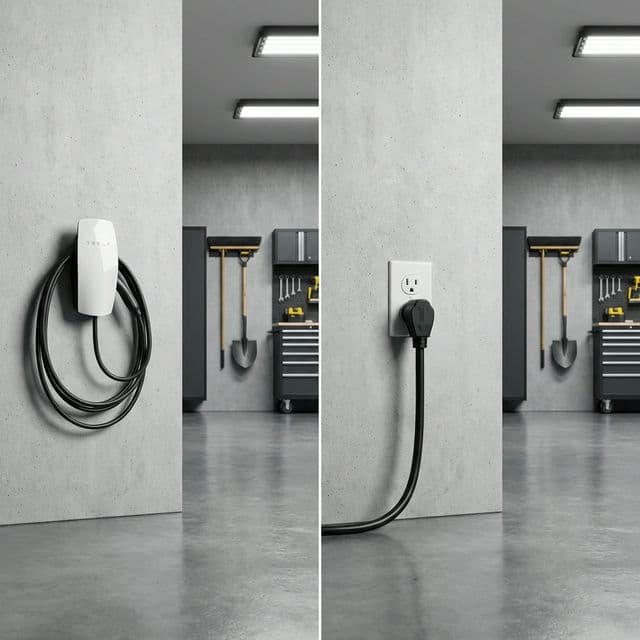
Ford F-150 Lightning Home Charger Installation: What Actually Works in 2026
The Ford F-150 Lightning has a bigger battery than most EVs on the road. The Extended Range hits 131 kWh. That is nearly double a Tesla Model 3. Charging it at home at the wrong amperage means 20+ hour charge times, and some Lightning owners discover this only after buying.
This guide covers every home charger option Ford supports, what each one actually delivers in charging speed, typical installation cost, and which setup is right for your driving pattern.
The Short Version
For Lightning Extended Range or Standard Range owners:
- Daily commute under 50 miles: NEMA 14-50 with Ford Mobile Power Cord works fine
- Daily commute 50 to 100 miles: Ford Charge Station Pro (48 amp) is the sweet spot
- Heavy work truck use, 150+ miles daily: Charge Station Pro at 80 amps, requires 100 amp subpanel
Typical installation cost (ranges reported for Nevada installs, Q2 2026; your quote will vary):
- NEMA 14-50 outlet only: $375 to $925
- Ford Charge Station Pro at 48A: $1,400 to $2,100 (unit + install)
- Ford Charge Station Pro at 80A: $2,200 to $3,500 (often requires panel work)
Ford Lightning Charging Options
Option 1: Ford Mobile Power Cord (Included)
Every Lightning ships with a Mobile Power Cord. It has a NEMA 14-50 plug by default, and accepts different adapters for other outlets.
Specs:
- Up to 32 amps on a 240V NEMA 14-50 outlet
- 7.7 kW charging power
- Adds 10 to 13 miles of range per hour
- Adapters available for 120V (level 1) and smaller 240V outlets
Full-charge times (Mobile Power Cord at 32A on NEMA 14-50):
- Standard Range (98 kWh): 12 to 13 hours
- Extended Range (131 kWh): 15 to 16 hours
Good enough if you drive 40 to 60 miles a day and plug in every night. Not enough if you use the truck for real work.
Option 2: Ford Charge Station Pro (Most Common)
This is the hardwired Level 2 charger Ford sells for Lightning owners. Extended Range trucks ship with it included as of 2023 onward; Standard Range buyers pay $1,310 separately.
Specs:
- Configurable from 30A to 80A output
- At 48A on a 60A circuit: 11.5 kW, about 30 miles of range per hour
- At 80A on a 100A circuit: 19.2 kW, about 50 miles of range per hour
- Hardwired installation
- Works with Intelligent Backup Power (more on this below)
- Built-in Wi-Fi and FordPass app integration
Full-charge times (Charge Station Pro at 48A):
- Standard Range: 8 to 9 hours
- Extended Range: 10 to 11 hours
Full-charge times (Charge Station Pro at 80A):
- Standard Range: 5 to 6 hours
- Extended Range: 6.5 to 7 hours
Option 3: Third-Party 48A or 80A Charger
ChargePoint Home Flex, Emporia Smart Level 2, and Wallbox Pulsar Plus all handle Lightning charging. Most top out at 48A to 50A, which matches the Charge Station Pro in everyday use.
Why consider a third-party unit?
- Often $100 to $300 cheaper than the Ford unit
- Some have better apps (ChargePoint and Emporia especially)
- Multi-brand households (Lightning plus a Tesla) benefit from a J1772 connector
- Most do not support Ford's Intelligent Backup Power feature (important caveat)
The Intelligent Backup Power Decision
This is the single biggest reason to buy the Ford Charge Station Pro over a third-party charger.
What it is: The Lightning's 131 kWh battery can power your home during an outage, up to 9.6 kW continuous. The Charge Station Pro, combined with Ford's Home Integration System, makes this possible.
What you need:
- Ford Charge Station Pro at 80A
- Home Integration System (Sunrun handles installs nationally, but locally approved electricians can do it)
- Transfer switch wired into your main panel
- Typical range reported for the full backup setup: $4,500 to $7,800; your quote will vary
What you get: Whole-house backup for 3 to 10 days depending on load. With AC running full time in a Henderson summer, expect the low end of that range.
Need a professional installation quote?
Get matched with a qualified local installer for a written quote. Free, no obligation.
Reality check: The full backup system is expensive, and recharging during a long outage generally requires solar. Many owners skip it and rely on a standalone generator or a home battery for backup if they need it.
Do You Actually Need 80 Amps?
This is where Lightning owners can spend money they did not need to.
80A charging (19.2 kW) makes sense if:
- You drive 120+ miles per day consistently
- You use the truck for work (contractor, landscaping, construction)
- You tow frequently (Lightning range drops 40 to 50 percent while towing)
- You have multiple heavy-use EVs in the household
48A charging (11.5 kW) is enough if:
- Daily driving under 80 miles
- You charge overnight (8 plus hours available)
- You do not tow daily
- Your panel cannot easily support 100 amps of EV load
32A charging (7.7 kW via Mobile Power Cord on NEMA 14-50) is enough if:
- Daily driving under 50 miles
- You charge overnight
- Budget is the main constraint
For most Lightning owners, 48A is the practical sweet spot. 80A only makes sense with the panel capacity to support it, and some owners stay with the Mobile Power Cord on a NEMA 14-50.
Installation Cost in Henderson, NV (2026)
These are typical ranges reported for Nevada installs; your quote will vary.
NEMA 14-50 + Mobile Power Cord
- Outlet, breaker, wire, labor, permit: $375 to $925
- No additional charger purchase needed (Mobile Power Cord is included)
- Total: $375 to $925
Ford Charge Station Pro at 48A
- Charger unit: $1,310 (or included with Extended Range Lightning)
- 60A breaker, 6 AWG wire, conduit, labor: $400 to $700
- Permit: $75 to $150
- Total: $475 to $850 installed (if you already have the charger), or $1,785 to $2,160 if you need to buy it
Ford Charge Station Pro at 80A
- Charger unit: $1,310
- 100A breaker, 3 AWG wire, conduit, labor: $800 to $1,500
- Subpanel if needed: $600 to $1,200
- Permit: $75 to $150
- Total: $1,475 to $2,850 installed (plus charger cost if needed)
Panel Upgrade If Your Panel Can Not Handle It
- 200A panel upgrade: $2,200 to $3,800
- Service entrance conductor upgrade (rare but sometimes needed): additional $500 to $1,500
- NV Energy service coordination: may add 5 to 10 business days to the timeline; confirm with NV Energy
Henderson-Specific Considerations
Heat and Lightning charging:
The Lightning onboard charger derates (slows down) above 113 degrees F battery temp. In Henderson summer afternoons, charging speed drops noticeably even on an 80A circuit. Park in shade, pre-cool the battery using the Ford app, or charge overnight when it is cooler.
HOA restrictions:
Nevada NRS 111.239 limits an HOA's ability to prohibit EV charger installation. HOAs may still set reasonable conditions, so check your CC&Rs and the statute, and notify your HOA before starting work.
Permit process:
Every Lightning install needs a City of Henderson electrical permit. For 80A installs, expect load calculations to matter even more than on a 48A install. Your installer normally handles permits and inspections; confirm this in your quote.
Cold weather (rare but real):
Henderson hits freezing a few nights each winter. Lightning preconditioning pulls additional 2 to 4 kWh from your home circuit during cold mornings. On a 48A circuit, this is absorbed. On a Mobile Power Cord on 14-50, charging speed can drop during preconditioning.
Ford Pro Charging Station (Commercial Version)
For Lightning owners who use the truck primarily for business (contractors, fleet operators), Ford Pro Charging Station is a different animal. It supports up to 19.2 kW for a single truck, plus OCPP smart features for fleet managers.
Pricing runs $1,800 to $2,600 for the unit and $2,800 to $4,500 installed. They make sense for fleet or contractor-office use. For single-truck home use, it is overkill.
What About the 2025+ Refresh Lightning?
The refreshed Lightning keeps the same charging architecture. Nothing changes on the home charging side. If you are upgrading from an earlier Lightning, your existing Charge Station Pro works with the new truck.
Which Setup Fits Which Driver
1. Commuter with a daily 40 to 70 mile drive: NEMA 14-50 + Mobile Power Cord. Save $1,300 plus install cost.
2. Daily driver with 70 to 120 mile commute or weekend towing: Charge Station Pro at 48A. The faster charging is worth the $1,300 plus install.
3. Work truck, 150+ miles daily, frequent towing: Charge Station Pro at 80A with a subpanel if needed.
4. Serious about home backup power: Charge Station Pro at 80A with Home Integration System. Understand this can mean spending $5,000 to $8,000 for a feature you may rarely use.
Frequently Asked Questions
Does every Ford Lightning come with a Charge Station Pro?
No. Extended Range trucks have included the Charge Station Pro since 2023. Standard Range trucks come with the Mobile Power Cord only. Charge Station Pro costs $1,310 direct from Ford if you need to buy it separately.
Can I use a Tesla Wall Connector with my Ford Lightning?
Yes, if you have the Tesla Universal Wall Connector (built-in J1772) or add a NACS to J1772 adapter. Some 2025+ Lightnings support native NACS charging. Check your specific build.
How long does Ford Lightning installation take in Henderson?
On-site work commonly takes 2 to 5 hours for a 48A install and 4 to 8 hours for 80A. The full process including permit and final inspection commonly runs 5 to 10 business days.
Can I run 80A charging on a 200A main panel?
Sometimes. 80A continuous is a huge load. You need to run a load calculation. If your home has central AC (common in Henderson), electric water heater, electric dryer, electric range, and a pool pump, 80A is usually too much without a main panel upgrade or a demand management system.
Is Ford Intelligent Backup Power worth it in Henderson?
It depends on how much outage risk you face. The $5,000 to $8,000 typical cost is hard to recover through savings alone, so it tends to make the most sense for homeowners who work from home and cannot tolerate downtime, or who have medical or other critical loads. Ask NV Energy about outage history for your address.
Ready to install a charger for your Lightning? Request a free installation estimate and we'll match you with a qualified local installer. Ask them to confirm the permit, load calculation, and workmanship warranty in writing.
Disclaimer: Educational content only. Actual charging speeds and installation requirements depend on your specific truck, battery, home electrical system, and local permit requirements. Always work with a licensed electrician for EV charger installation.