
Commercial EV Charger Installation: What Businesses Need to Know
Quick answer: Commercial EV charger installation differs from a home install mainly in scale and load planning -- multiple stations sharing one electrical service, load management to avoid overloading that service, and (for new construction or major renovations) accessible-parking requirements. Costs range from a few thousand dollars for a couple of basic stations to well into six figures for a multi-port site needing a utility service upgrade.
The Three Common Use Cases
Commercial EV charging generally falls into one of three categories, and each has a different load profile:
1. Employee/workplace charging -- A handful of stations for staff to charge during the workday. Lower daily utilization per port, simpler load profile, often the easiest to size and budget for.
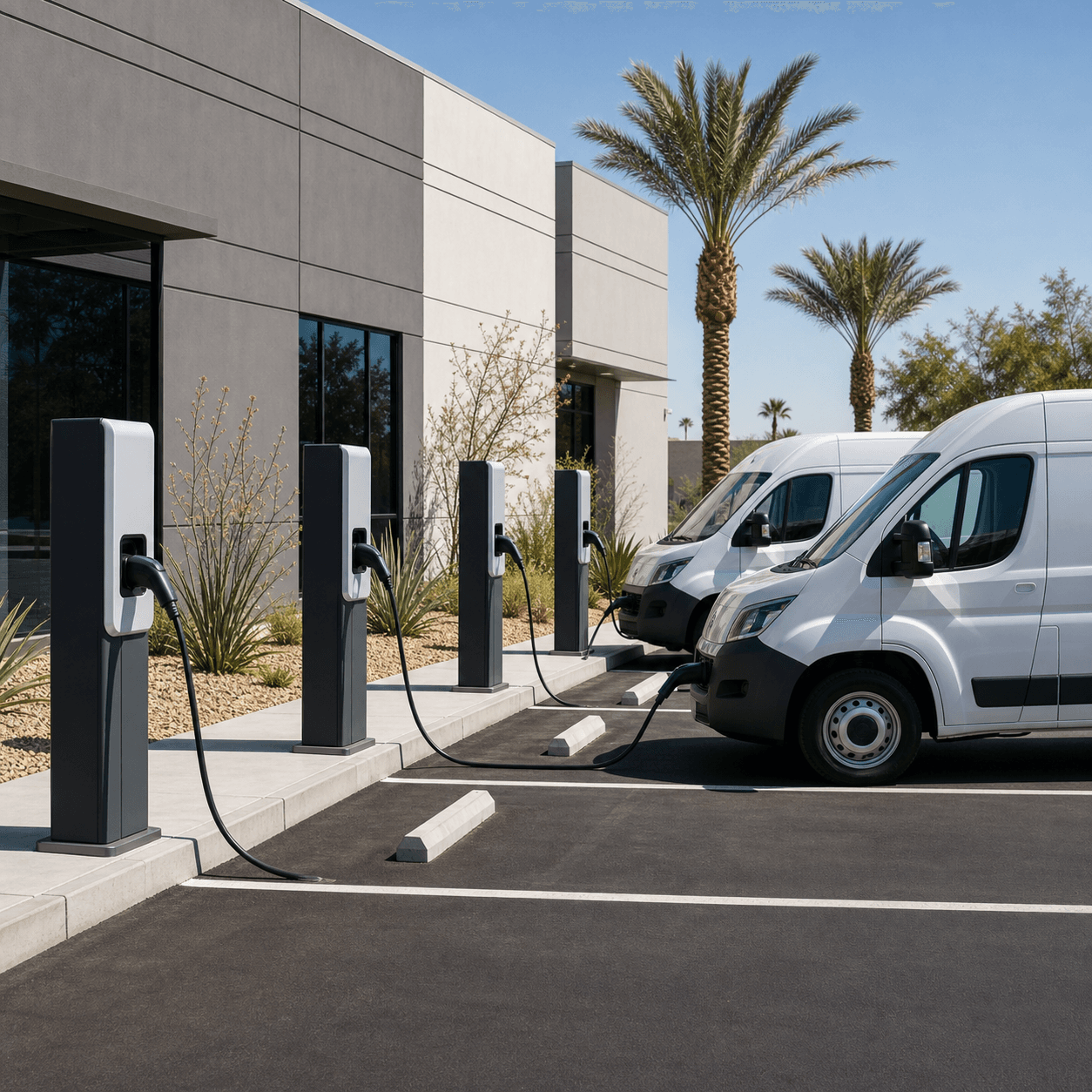
2. Fleet charging -- Charging a company's own vehicles (delivery vans, service trucks, sales fleet) overnight or between shifts. Requires planning around fleet size, vehicle battery capacity, and route/shift schedules -- you need enough charging capacity to fully replenish the fleet in the available window.
3. Customer-facing charging -- Stations meant to attract EV-driving customers to a retail, hospitality, or office location. Usually paired with payment processing, networked billing, and public-facing signage, and sees the most variable, hardest-to-predict utilization.
Load Calculations for Multiple Stations
The core planning question for any multi-port site is: what's the actual peak demand, not the theoretical maximum if every port ran at full power simultaneously.
- Each Level 2 port typically draws 30-48A continuous when active.
- A site with 10 ports at 48A each would need 480A of continuous capacity if all ran at once -- which rarely happens in practice.
- Load management systems (also called dynamic load management or DLM) monitor real-time demand and throttle individual ports so the total draw stays within the service's actual capacity, letting a site support more stations than a naive per-port sum would suggest.
- A qualified electrical engineer or electrician performs a load calculation (per NEC Article 220) that accounts for demand factors specific to EV charging, existing building loads, and any planned future expansion.
Skipping this step and just adding up nameplate ratings is the most common way a commercial EV charging project's budget balloons mid-project once the utility flags insufficient service capacity.
Panel and Service Capacity Planning
For anything beyond 2-3 ports, the question quickly becomes whether the building's existing electrical service has enough spare capacity:
- Small deployments (2-4 ports) may fit within an existing panel's spare breaker slots and capacity, similar to a large residential job.
- Mid-size deployments (5-15 ports) often require a subpanel dedicated to EV charging, sized with room for future stations.
- Large deployments (15+ ports, or any fleet depot) frequently require a utility service upgrade -- sometimes including a new transformer -- which involves utility coordination and can add months to a project timeline, not just days.
Get a load calculation and a site electrical assessment before committing to a specific number of ports. The gap between "what we want to install" and "what the existing service supports without upgrades" is the single biggest driver of commercial EV charging project cost and timeline.
Accessible Parking Considerations
In Henderson or Las Vegas?
Henderson EV Charger Pros handles permits, wiring, and installation locally. See our written Henderson-area pricing.
For new construction and major renovations, EV charging stations in parking areas may need to meet accessibility requirements for van and passenger accessible spaces, similar to standard accessible parking requirements -- exact requirements vary by state and local building code, and some jurisdictions have adopted EV-specific accessible charging standards on top of general ADA accessible-parking rules. This is a code-compliance question for your architect, electrical engineer, or local building department, not something to assume based on a general rule of thumb -- verify the specific requirement for your jurisdiction and project type before finalizing a site layout.
What Drives Commercial Installation Cost
- Number of ports. Cost scales with port count, but not linearly -- shared infrastructure (trenching, panel/subpanel, load management) gets more cost-efficient per port as the deployment grows.
- Networked vs. non-networked stations. Networked stations (with payment processing, usage reporting, and remote management) cost more per unit than basic non-networked Level 2 stations, but are close to mandatory for customer-facing or fleet-management use cases.
- Trenching and conduit runs in a parking lot. Underground conduit runs across a parking lot or structure add materially to cost versus a station mounted near the existing panel.
- Utility service upgrades. As covered above, this is the largest single cost variable for larger deployments -- a new transformer or service upgrade can run well into five or six figures depending on utility and site conditions.
- Load management hardware/software. Adds upfront cost but can meaningfully reduce the electrical service capacity (and therefore utility upgrade cost) needed for a given port count.
Incentives for Commercial Installations
Businesses may be eligible for a version of the federal Alternative Fuel Vehicle Refueling Property Credit (Section 30C) for business/depreciable property, which has different terms than the residential credit covered in our EV charger tax credit guide -- verify the current business-use terms and cap separately, since they differ from the residential figures. Many utilities and states also run separate commercial/fleet EV charging incentive programs; check with your utility and state energy office for current program status, since these vary widely and change often.
Getting Started
1. Define your use case (employee, fleet, or customer-facing) -- it drives every downstream decision
2. Get a site electrical assessment and load calculation before committing to a port count
3. Decide on networked vs. non-networked stations based on your use case
4. Budget for the possibility of a utility service upgrade if you're planning more than a handful of ports
5. Check current federal, state, and utility incentive programs before finalizing your budget
For the residential/single-charger cost breakdown that underlies much of this math, see our EV charger installation cost guide.
If you're a Henderson or Las Vegas business exploring workplace or fleet charging specifically, see our commercial EV charging installation guide for Henderson/Las Vegas for local station counts, load management setups, and installed costs from real local projects.
Frequently Asked Questions
How much does commercial EV charger installation cost?
It depends heavily on port count and whether a utility service upgrade is needed. A small 2-4 port employee charging setup can run similarly to a large residential job (a few thousand dollars per port), while a larger fleet depot or customer-facing site needing a service upgrade can run into six figures. Get a site-specific assessment rather than assuming a per-port average applies to your site.
Do I need a load calculation for a commercial EV charging project?
Yes, for any multi-port installation. A load calculation determines the actual peak demand your stations will place on the electrical service, accounting for demand factors and load management, rather than assuming every port draws its maximum rating simultaneously.
What's the difference between networked and non-networked commercial chargers?
Networked stations connect to a cloud platform for payment processing, usage reporting, and remote management -- useful for customer-facing or fleet-management use cases. Non-networked stations are simpler and cheaper per unit but lack that reporting and billing capability, which is usually fine for basic employee charging.
Do commercial EV chargers qualify for tax credits?
Businesses may be eligible for a business-use version of the federal 30C credit, which has different terms and caps than the residential credit. Verify current business-use eligibility and cap amounts separately -- don't assume the residential figures apply.
This guide is for general informational purposes. Costs, code requirements, and incentive programs vary by jurisdiction, utility, and project scope, and change over time. Consult a licensed electrician or electrical engineer for a site-specific assessment and a tax professional for incentive eligibility.