
EV Charger Load Management: How It Works & When You Need It
Quick answer: Load management is hardware or software that monitors real-time electrical demand and automatically limits EV charger output so a panel's total load never exceeds its safe capacity. It matters most when a panel has limited spare capacity, or when two or more EVs (or an EV plus other high-draw appliances) share one panel. It's typically far cheaper than a full panel upgrade -- often a few hundred dollars versus $1,800-$3,500 -- when it solves the same underlying capacity problem.
What Load Management Actually Does
An EV charger circuit is sized for its maximum draw -- a 48A charger needs a 60A breaker and enough spare panel capacity to support it continuously. Without load management, that capacity has to be reserved permanently, whether or not the charger is actually pulling that much power at any given moment.
Load management changes that by dynamically adjusting charger output based on what the rest of the panel is actually doing:
- If the panel has spare capacity (most of the day), the charger runs at full rated output.
- If other loads spike (AC compressor kicking on, an electric range in use, a second EV plugged in), the system throttles the charger's output in real time to stay within the panel's total safe capacity.
- Once those other loads drop, the charger ramps back up.
This lets a panel support charging equipment that would otherwise require a full panel upgrade to accommodate on paper.
Hardware vs. Software Load Management
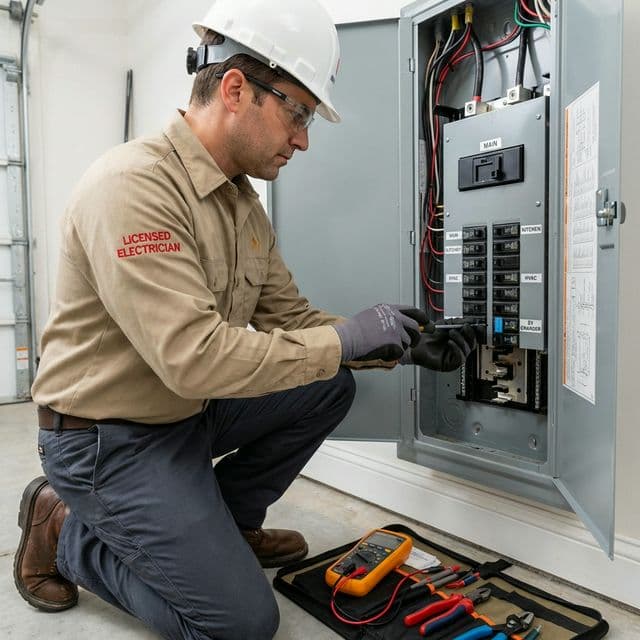
Hardware load management uses a physical current transformer (CT) clamped onto the main panel feed, wired to the charger(s), that measures real-time whole-panel current draw and signals the charger to throttle. This works with any charger that supports an external load management input, and it's the more common approach for retrofitting load management onto an existing panel.
Software / built-in power sharing is built into some manufacturers' own multi-unit ecosystems -- most notably, two or more Tesla Wall Connectors on the same circuit will automatically split available power between themselves without any additional hardware. This only works within that manufacturer's own charger lineup, and only addresses charger-to-charger sharing, not whole-panel monitoring against other household loads.
Whole-panel hardware load management is the more flexible option if you need the charger to respect other big household loads, not just share power between two chargers of the same brand.
When You Need It
In Henderson or Las Vegas?
Henderson EV Charger Pros handles permits, wiring, and installation locally. See our written Henderson-area pricing.
Load management is worth considering if:
- Your panel doesn't have full spare capacity for the charger's maximum rated draw, but does have enough for typical, non-peak usage
- You have (or plan to add) a second EV sharing one electrical service
- Your home has other large, intermittent loads (electric range, pool pump, high-output HVAC) that occasionally compete with charger demand
- A full panel upgrade is disproportionately expensive for your situation relative to a load management add-on
It's generally not worth it if your panel already has generous spare capacity for the charger's full rated draw with room to grow -- in that case, there's nothing to manage.
Load Management vs. a Straight Panel Upgrade
| Load management | Panel upgrade | |
|---|---|---|
| Typical cost | A few hundred dollars (hardware) or built into the charger (power sharing) | $1,800-$3,500 for a 100A to 200A upgrade |
| What it solves | Lets existing capacity be shared dynamically | Adds genuinely more capacity to the panel |
| Installation complexity | Add-on to existing wiring, no utility coordination needed | Requires a utility meter disconnect/reconnect, more permit scope |
| Best for | Marginal capacity gaps, multi-EV households, intermittent competing loads | Panels that are genuinely undersized for the home's total electrical needs, not just the charger |
For a genuinely undersized, older panel (100A serving an all-electric home, for instance), load management is a workaround, not a fix -- a panel upgrade is the more durable answer. See the EV charger installation cost guide for the full panel-upgrade cost breakdown and how to tell which situation you're in.
A Worked Two-EV Example
For a real worked example of how power sharing plays out for a two-EV household on a shared circuit -- including the math on charging time and the panel-upgrade cost it avoided -- see the two-EV scenario in our EV charging speed and cost guide (Henderson, NV example rates -- the power-sharing mechanics apply regardless of your local utility rate).
Frequently Asked Questions
Does load management slow down my charging?
Only when the rest of your panel is under heavy demand at the same moment -- and even then, most systems throttle just enough to stay within safe capacity rather than cutting power dramatically. For most overnight charging, when household demand is low, the charger runs at or near full rated output.
Can I add load management to an existing charger?
It depends on the charger. Many networked Level 2 chargers support an external load management input (current transformer) as an add-on. Check your specific charger's documentation, or ask your electrician during a site assessment.
Is load management the same as a smart charger?
Related but not identical. A "smart" charger typically refers to Wi-Fi/app connectivity, scheduling, and energy monitoring. Load management is specifically about responding to real-time electrical demand to protect panel capacity -- some smart chargers include it, some don't, and it can also exist as an add-on to a non-smart charger.
Will load management let me skip a panel upgrade entirely?
Sometimes, if your capacity gap is marginal or driven by intermittent loads. If your panel is genuinely undersized for your home's total electrical needs (not just the EV charger), a panel upgrade is still the more durable long-term answer.
This guide is for general informational purposes. Load management hardware, compatibility, and pricing vary by manufacturer. Consult a licensed electrician for a system sized to your specific panel and charging setup.