
NEMA 14-50: What It Is, EV Charging Use, Cost & Code
Quick answer: A NEMA 14-50 is a 240-volt, 50-amp outlet originally designed for electric ranges and RVs. For EV charging, it powers a portable Level 2 charger (like a Tesla Mobile Connector or a universal J1772 EVSE) at up to 32 amps continuous — about 7.5-8 kW, or roughly 25-30 miles of range added per hour. Installed cost typically runs $350-$900 depending on your panel's existing capacity and local labor rates. It requires a dedicated 40-50 amp circuit and, for EV charging specifically, GFCI protection under NEC 625.54.
What a NEMA 14-50 Actually Is
NEMA 14-50 is a receptacle standard set by the National Electrical Manufacturers Association -- the name refers to the physical shape and rating of the plug and outlet, not a brand. It's a 4-prong, 240-volt, 50-amp outlet that's been standard equipment in American homes for decades, long before EVs existed.
You'll find it in three common contexts:
- Electric ranges/ovens -- the original use case, still common in kitchens
- RV parks and driveways -- the standard 50-amp RV shore-power connection
- EV charging -- the newest use, popularized because Tesla ships a NEMA 14-50 adapter with its Mobile Connector, and most third-party portable EVSEs support it too
If you already have a NEMA 14-50 installed for a range or RV pad, it's usually compatible with EV charging -- but don't assume it without checking the breaker size and wiring gauge (see below). A dryer's NEMA 14-30 outlet is a different, lower-amperage standard and is not the same thing (see the NEMA 14-30 vs 14-50 comparison for the full breakdown).
NEMA 14-50 for EV Charging: Specs and Charging Speed
For EV charging, the outlet itself doesn't set your charging speed -- the portable EVSE you plug into it does. Here's what to expect from the most common setup:
| Spec | Value |
|---|---|
| Outlet rating | 240V / 50A |
| Continuous current draw (EV charging) | 32A (limited by most portable EVSEs, not the outlet) |
| Power delivered | ~7.7 kW |
| Approximate range added | 25-30 miles/hour, depending on vehicle efficiency |
| Circuit breaker required | 40A minimum (50A common; GFCI-protected -- see Code section) |
| Wire gauge | 8 AWG copper minimum for a 40A circuit, 6 AWG for 50A |
Some EVSEs (a minority) can be configured or are rated higher, up to the outlet's full 50A/40A-continuous limit -- check your specific charger's spec sheet rather than assuming 32A is a hard ceiling.
NEMA 14-50 vs. NEMA 6-50 vs. a Hardwired Level 2 Charger
This is the decision most people actually need help with, and it's rarely framed clearly:
| NEMA 14-50 | NEMA 6-50 | Hardwired Level 2 | |
|---|---|---|---|
| Voltage/amperage | 240V / 50A | 240V / 50A | Varies, commonly 240V / 40-60A |
| Neutral wire | Yes (4-prong) | No (3-prong) | N/A -- no plug |
| Typical use | Ranges, RVs, EV charging | Welders, some EV charging | EV charging only |
| EV charging speed | ~32A / 7.7 kW typical | Same amperage capability, EVSE-dependent | Often higher -- up to 48-60A depending on model |
| Portability | Portable EVSE unplugs and travels with you | Same | Fixed in place, no portable charger needed |
| Best for | Homeowners who want outlet flexibility or might switch EV brands | Installs where a neutral isn't otherwise useful and 6-50 is already present | Households wanting max charging speed and app/smart features long-term |
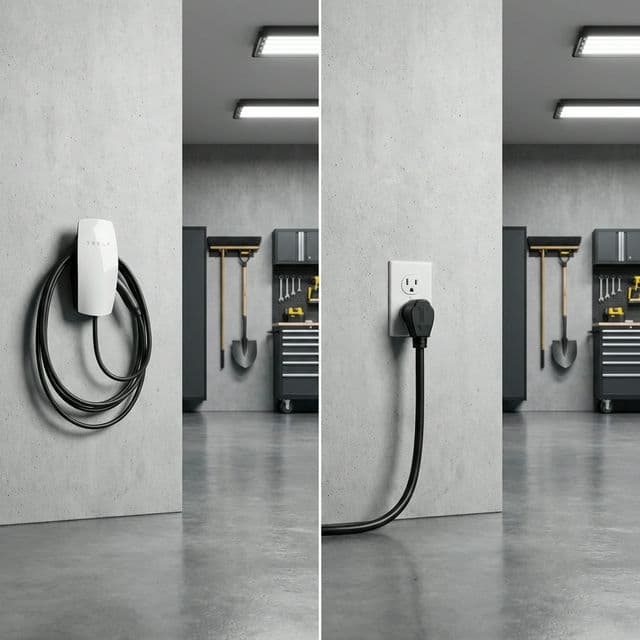
If you're starting from nothing (no existing outlet), the practical choice for most EV owners is between a NEMA 14-50 and a hardwired unit -- the 6-50 mostly matters if you already have one installed for another purpose (a welder, for example) and are deciding whether to reuse it. For the specific hardwired-vs-outlet tradeoff on a Tesla, see how it compares to a Tesla Wall Connector.
In Henderson or Las Vegas?
Henderson EV Charger Pros handles permits, wiring, and installation locally. See our written Henderson-area pricing.
Installation Cost
Installed cost for a NEMA 14-50 dedicated to EV charging generally breaks down as:
- Outlet and cover plate: $15-$30
- Breaker (GFCI-rated -- required for EV use, see Code section below): $130-$180
- Wire, conduit, and materials: $100-$300
- Electrician labor (1.5-3 hours): $150-$400
- Permit fee (varies by jurisdiction): $75-$150
Typical total: $350-$900, with the wide range driven mainly by how far the outlet is from your electrical panel and whether your permitting jurisdiction requires a separate inspection trip. Homes with an already-tight panel may need a load calculation or a panel upgrade first -- that's a separate cost, not part of the outlet install itself. For the full national cost picture across every charger type (outlet-only, hardwired, and Tesla-specific), see the EV charger installation cost guide or estimate your installation cost with our calculator.
(Figures above reflect a representative regional installation; get a written quote before committing -- labor rates and permit fees vary by state and city. Example: Henderson, NV installation pricing is available on [our pricing page](/pricing).)
Wiring and Code Requirements -- What to Know Before You Hire an Electrician
A NEMA 14-50 is a 240-volt, 40-50 amp circuit. That's enough current to cause a serious fire or shock hazard if installed incorrectly -- this is not a project for an unlicensed DIY installer, and this guide intentionally does not provide step-by-step wiring instructions. What's useful to know before you call an electrician:
- Dedicated circuit required. The outlet cannot share a breaker with anything else -- no daisy-chaining off an existing circuit, even if it "has room" on paper.
- GFCI protection is required for EV charging. Under NEC 625.54, any 125V-250V receptacle rated 50A or less that supplies EV charging equipment needs GFCI protection -- either a GFCI breaker or a GFCI-protected receptacle. This is a relatively recent code requirement and is the single biggest reason installed cost has crept up over the last few NEC cycles (a GFCI-rated 50A breaker runs $130-180 versus $20-30 for a standard breaker).
- Industrial-grade receptacle matters. Residential-grade NEMA 14-50 outlets are not rated for the sustained, hours-long draw of EV charging and are known to fail (overheat, loosen) under that load pattern. Ask your electrician specifically for an industrial/commercial-grade receptacle (common examples: Hubbell or Bryant hospital-grade models) -- this is a real cost/safety tradeoff, not upselling.
- Panel capacity has to support it. A licensed electrician should run a load calculation confirming your panel has 40-50 amps of spare capacity before installing. If it doesn't, a panel upgrade (a separate project, typically $1,800-$3,500) may be a prerequisite.
- Permit and inspection. Nearly every US jurisdiction requires an electrical permit for a new 240V circuit. Skipping this isn't just a legal risk -- it can void your homeowner's insurance claim if the wiring later causes damage.
If you want the concepts behind these rules in more depth, the relevant NEC (National Electrical Code) articles are 625.17 (EVSE cable/overcurrent protection), 625.40 (dedicated branch circuit requirement), 625.41 (125% continuous-load overcurrent protection sizing), and 625.54 (GFCI requirement) -- ask your electrician to confirm compliance with the current edition adopted in your jurisdiction, since some areas lag the national NEC release by a code cycle or two.
Federal Tax Credit and Rebates
A NEMA 14-50 installed for EV charging can qualify for the federal 30C Alternative Fuel Vehicle Refueling Property Credit (30% of installed cost, capped per current IRS rules, claimed on Form 8911) -- eligibility depends on your address falling in a qualifying census tract, and the program's terms are subject to change. Verify current eligibility and cap amounts before assuming this applies to your install; don't rely on a fixed dollar figure without checking the current program status. See our EV charger tax credit guide for the full eligibility and filing walkthrough.
Frequently Asked Questions
Is a NEMA 14-50 the same as what my electric range uses?
Often yes -- many range and EV installations use the identical NEMA 14-50 standard. If you already have one for a range, an electrician can confirm whether the existing circuit's breaker size and wire gauge support EV charging too, or whether a separate dedicated circuit is needed.
Can I install a NEMA 14-50 myself?
This is a 240V/40-50A circuit -- a serious shock and fire risk if done incorrectly, and it requires a permit and inspection in nearly every jurisdiction. Hire a licensed electrician.
Do I need a NEMA 14-50 or can I just use a regular outlet?
For Level 2 EV charging (the speed most home charging setups target), you need a 240V circuit -- a standard 120V household outlet only supports much slower Level 1 charging (roughly 3-5 miles of range per hour). The NEMA 14-50 is one of several 240V outlet standards; whether it's the right one depends on your specific EVSE's plug requirements.
Does a NEMA 14-50 need a neutral wire?
Yes -- that's the defining difference from a NEMA 6-50, which is otherwise similar in voltage and amperage but lacks the neutral conductor.
How fast does a NEMA 14-50 charge an EV?
Most portable EVSEs plugged into a NEMA 14-50 draw 32 amps continuous (about 7.7 kW), adding roughly 25-30 miles of range per hour depending on the vehicle. Some EVSEs support higher draw up to the circuit's rated capacity -- check your charger's spec sheet.
This guide is for general informational purposes. Charging speeds, costs, and code requirements vary by equipment, jurisdiction, and current code edition. Always have EV charging equipment installed by a licensed electrician who can evaluate your specific electrical system and local code requirements.