
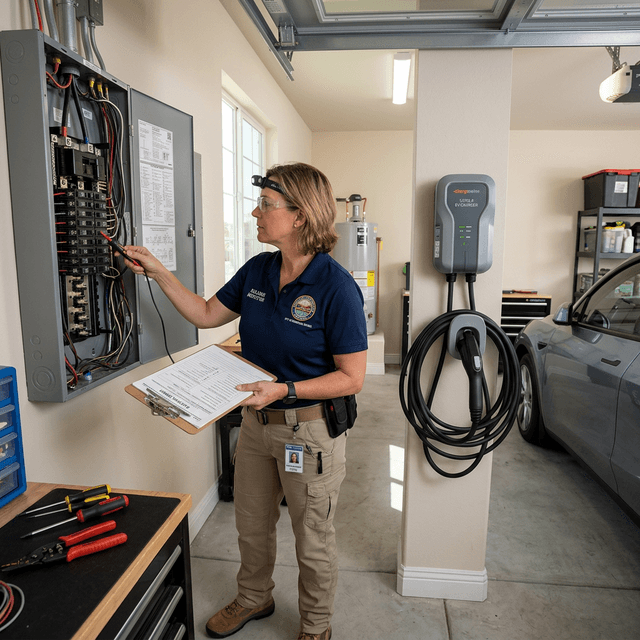
EV Charger Installation Requirements
Quick answer: A Level 2 home charger needs a dedicated 240V circuit with a breaker sized at 125% of the charger's amperage, wiring rated for that load, ground-fault protection, enough spare capacity in your electrical service, and in most places a permit and inspection. An installer confirms each item for your home. This guide explains what they are checking and why.
The Checklist an Installer Works Through
| Requirement | What it means | Who determines it |
|---|---|---|
| Service and panel capacity | Your home's total electrical service can support the added charging load | Installer's load calculation |
| Dedicated circuit | The charger has its own breaker and wiring, shared with nothing else | Code requirement |
| Breaker size | 125% of the charger's continuous amperage | Code requirement |
| Wire size | Thick enough for the breaker, and for the run length | Installer, per code tables |
| Ground-fault protection | Shock protection for the charger or outlet | Code and charger design |
| Mounting location | Reach to the charge port, protection from damage and weather | Installer with homeowner |
| Permit and inspection | Local approval of the work | Installer and local building department |
Panel and Service Capacity
The most common surprise is not the charger, it is whether the home has room for it. Electrical service is sized in amps, commonly 100A, 150A or 200A in homes. An installer estimates your existing load using the methods in the National Electrical Code, then checks whether a new charging load fits. Panel age alone does not decide it: a 100A home with gas appliances may have room, while a 200A all-electric home with a pool and two air conditioners may not.
If capacity is short you generally have three options: reduce the charger's amperage, add load management so the charger backs off when other loads are high, or upgrade the panel or service. A panel upgrade is the most expensive route and is worth ruling out before paying for it.
Dedicated Circuit and Breaker Size
An EV charger must be on its own branch circuit. Because charging is a continuous load, the circuit is sized at 125% of the charger's rating (equivalently, the charger uses no more than 80% of the breaker):
| Charger | Continuous draw | Minimum breaker |
|---|---|---|
| 24A | 24A | 30A |
| 32A | 32A | 40A |
| 40A | 40A | 50A |
| 48A | 48A | 60A |
Many chargers can be set to a lower current than their maximum, which lets a smaller circuit serve them. That is a common way to fit a charger onto a tight panel.
Wire Size and Run Length
Wire has to carry the breaker's rating without overheating, so a bigger breaker means thicker copper. The distance from panel to charger matters too: long runs may need a larger wire to limit voltage drop, and outdoor or underground runs need conduit or cable rated for the location. Exact sizing depends on the wire type, temperature ratings of the terminals and the run, so it is set by the installer from code tables and not a rule of thumb. This is also why distance from the panel is the biggest driver of cost. See the cost guide.
Plug-In vs Hardwired Requirements
A plug-in charger uses a receptacle such as a NEMA 14-50 on a 50A circuit, which supports a charger drawing up to 40A continuously. A hardwired charger connects directly and can support up to 48A on a 60A circuit. The outlet must be a quality, correctly rated device, since a loose or cheap receptacle under continuous load is a known failure point. Details are in the NEMA 14-50 guide.
Ground-Fault Protection
In Henderson or Las Vegas?
Get matched with a local installer for a free, written quote.
Charging equipment includes personnel protection against ground faults, and current editions of the NEC also require ground-fault protection for EV charging outlets. Whether it is built into the charger or provided by a GFCI breaker depends on the product and the code edition your jurisdiction has adopted. If a GFCI breaker keeps tripping, see the GFCI breaker guide.
Location, Indoor and Outdoor
Choose a spot that lets the cable reach the charge port with the car parked normally, that is not exposed to vehicle impact, and that keeps the cable out of walkways. Outdoor units need an appropriate weather-rated enclosure and, in Henderson's climate, some attention to heat and direct sun. See outdoor installation and the garage placement tips.
Permit and Inspection
A new 240V circuit generally requires an electrical permit and an inspection by the local building department. Installers normally pull the permit; confirm in writing who does and whether inspection is in the quote. Nevada requires contractors to be licensed by the Nevada State Contractors Board. See the permit guide. Building departments adopt specific code editions and can add amendments, so confirm local requirements with the City of Henderson or your jurisdiction.
What to Have Ready Before You Request Quotes
- Your vehicle make, model and year (and its maximum AC charging rate, if known)
- The charger you own or the type you want: plug-in, hardwired, or undecided
- A photo of your electrical panel, including the label showing its amp rating
- Where you plan to park and charge, and the approximate distance from the panel
- Whether the garage is attached or detached
- Your target timeline
The quote form collects exactly this, so an installer can give a real estimate instead of a generic range.
Do Not Do This Yourself
Wiring a 240V circuit involves live service conductors and is regulated for good reason. Undersized wire, loose terminations and skipped inspections are the causes of most EV charger fires. Hire a licensed electrician, and verify their license number with the Nevada State Contractors Board before work starts.
Frequently Asked Questions
What electrical service do I need for a Level 2 charger?
There is no single minimum. A load calculation on your home decides. Many 200A homes have room for a 40A or 48A charger, and many 100A homes can still fit a lower-amperage charger or use load management.
Does an EV charger need its own circuit?
Yes. It must be a dedicated branch circuit, not shared with outlets, lights or other appliances.
What size breaker do I need for a 40-amp EV charger?
A 50A breaker, because the circuit is sized at 125% of the continuous load.
Can I install a charger without a permit?
Do not. A new 240V circuit generally requires a permit and inspection, and unpermitted work can cause insurance and resale problems.
Will I need a panel upgrade?
Not always. An installer's load calculation decides. Lowering the charger's current or adding load management often avoids one.
Get Local Installation Quotes
Request a free installation estimate and we will share your project details with a local installer who can confirm these requirements for your home. We are an independent referral service, not an electrical contractor; verify the installer's license, insurance and written scope before you hire.
This guide is for general information, not electrical advice. Code editions and local amendments vary; confirm requirements with your building department and a licensed electrician. Sources: NFPA 70 National Electrical Code Article 625 (electric vehicle power transfer system) and Article 210. Last reviewed 2026-09-29.