
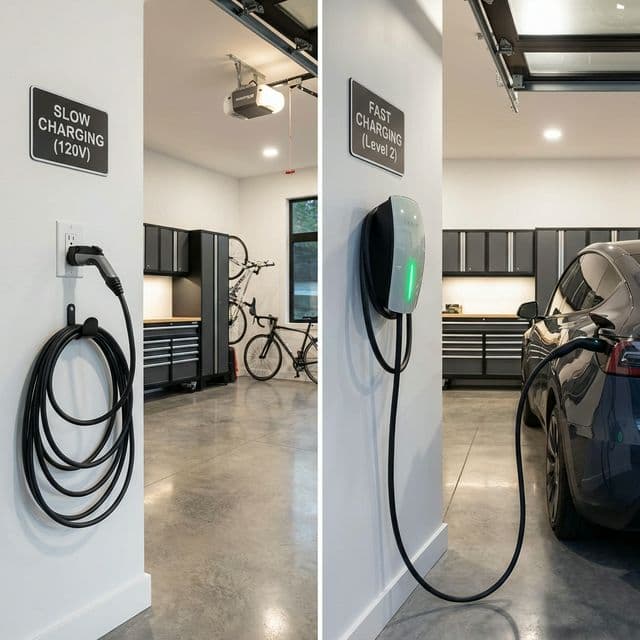
Level 2 EV Charger for Home: What It Is and What You Need
Quick answer: A Level 2 charger runs on a 240-volt circuit, like an electric dryer or oven, and is the standard way to charge an EV at home. Depending on its amperage it adds roughly 20 to 45 miles of range per hour, enough to refill most drivers' daily use overnight. It needs its own dedicated circuit, so the real questions are how many amps you want, whether your panel has room, and whether to plug it in or hardwire it.
Level 1 vs Level 2 in One Table
| Level 1 | Level 2 | |
|---|---|---|
| Voltage | 120V household outlet | 240V dedicated circuit |
| Typical power | About 1.4 kW | About 7.7 to 11.5 kW |
| Range added per hour | Roughly 3 to 5 miles | Roughly 20 to 45 miles |
| Installation | Plug into an existing outlet | Dedicated circuit, usually a permit |
Level 1 is fine for a plug-in hybrid or a very low-mileage driver. Most full EV owners end up wanting Level 2. The Level 1 vs Level 2 guide covers that decision in detail.
Charging Speed by Amperage
Power is volts times amps. On a 240V circuit:
| Charger output | Power | Approx. range added per hour* | Breaker it typically needs |
|---|---|---|---|
| 32A | 7.7 kW | ~20 to 30 miles | 40A |
| 40A | 9.6 kW | ~25 to 38 miles | 50A |
| 48A | 11.5 kW | ~30 to 45 miles | 60A |
*Range per hour depends on the vehicle's efficiency, which commonly runs from about 2.5 to 4 miles per kWh, and on temperature.
Two limits apply. First, your vehicle's onboard charger sets a ceiling: many EVs cannot accept more than 32A or 40A, so a 48A charger will simply charge them at the car's maximum. Check your owner's manual before paying for capacity you cannot use. Second, a higher-amperage charger needs a bigger circuit, which can mean thicker wire and possibly panel work. See the amperage guide for how to pick.
Why the Breaker Is Bigger Than the Charger
EV charging is a continuous load, meaning it runs for three hours or more. Electrical code sizes the circuit at 125% of a continuous load, which is why a 32A charger sits on a 40A breaker and a 48A charger on a 60A breaker. This is a code requirement, not an upsell. The installation requirements guide explains the rest of the circuit rules.
Plug-In vs Hardwired
- Plug-in (NEMA 14-50 outlet): the charger plugs into a 50A outlet. It is flexible and lets you take a portable unit with you, but the outlet and plug are wear points under daily use, and a 50A outlet caps continuous charging at 40A. Read the NEMA 14-50 guide.
- Hardwired: the charger connects directly to the circuit with no plug. It avoids the outlet as a failure point and can support 48A. Most permanent home setups end up hardwired.
In Henderson or Las Vegas?
Get matched with a local installer for a free, written quote.
Neither is unsafe when installed correctly. The tradeoff is flexibility against durability and top speed.
Choosing a Charger
Features worth comparing before you buy:
- Amperage: match it to what your car accepts and your panel can support.
- Connector: most non-Tesla EVs use J1772, while Tesla and a growing number of newer models use the NACS port. Adapters exist for both directions, so confirm what your vehicle has. See the J1772 to NACS adapter guide.
- Cable length: measure from the planned mounting spot to the charge port with the car parked normally.
- Weather rating: required if it will be mounted outside. See outdoor installation.
- Smart features: Wi-Fi scheduling helps if you are on a time-of-use rate; it is optional otherwise.
- Power sharing: useful for two EVs on one circuit. See load management.
- Warranty: compare the manufacturer's terms. Installation workmanship is warranted by the installer you hire, not by this site.
For product comparisons, see best home EV chargers.
What Installation Involves
A typical project has four parts: an installer assesses your panel capacity and the route from panel to parking spot, pulls a permit where required, installs the breaker, wiring and charger, and then the city inspects the work. Cost swings mainly with wire run length, panel capacity and whether trenching is needed. Use the installation cost estimator for a range based on your setup, and read the cost guide for what drives it.
Do not attempt to wire a 240V circuit yourself unless you are a licensed electrician. Errors here are fire and shock hazards, and unpermitted work can create insurance and resale problems.
Frequently Asked Questions
How fast does a Level 2 charger charge?
Most add roughly 20 to 45 miles of range per hour, depending on the charger's amperage and your vehicle. A car that used 40 miles in a day is typically refilled in one to two hours on a 32A charger.
Do I need a 48-amp charger?
Usually not. Many vehicles accept 32A to 40A at most, and 32A to 40A refills a typical daily commute overnight. Choose 48A only if your car can use it and you want the fastest home charging.
Do I need a permit to install a Level 2 charger?
Installing a new 240V circuit generally requires an electrical permit and inspection. See the permit guide and confirm requirements with the City of Henderson or your local building department.
Can I use my dryer outlet?
Only if it is the right type and rating for the charger, and it is not shared with another appliance. Have an electrician confirm the circuit and outlet before you use it.
Can my panel handle a Level 2 charger?
It depends on your service size and existing loads, not on panel age alone. An installer performs a load calculation. If capacity is tight, load management can sometimes avoid a panel upgrade.
Get Local Installation Quotes
Once you know what you want, request a free installation estimate and we will share your project details with a local installation professional who can quote your actual home. We are an independent referral service, not an electrical contractor; verify the installer's Nevada license, insurance and written scope before you hire.
This guide is for general information, not electrical advice. Requirements depend on your home, local code and the equipment you choose. Last reviewed 2026-09-29.